Artificial Intelligence was once seen as a threat to academia. But according to recent reports, between 80 and 90% of students use AI in their coursework.
It is clear that we cannot entirely forbid students from using AI for coursework. But using it accurately while considering academic integrity is something we should emphasise as parents, fellow students, and teachers.
Every academic institution has its own policies regarding the use of AI. Some might completely forbid its use, some might allow partial usage, while some institutions allow using AI and just being transparent about where they have used it.
In this blog, we will discuss when and how students can use AI in their coursework so that it protects their grades, academic integrity, and reputation.
Can AI Be Used for Coursework?
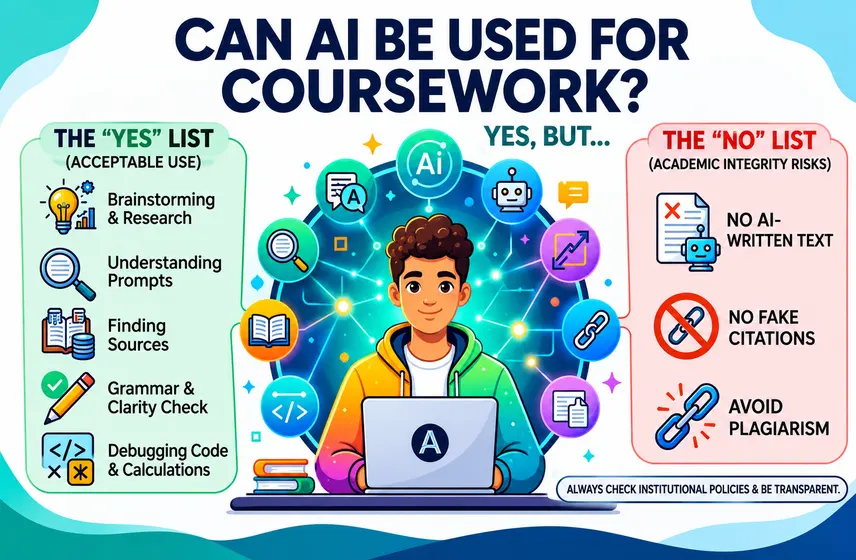
Simply put: Yes, students can use AI for coursework, but rules vary strictly by institution, department, and individual instructor. It is only accepted to use it for certain academic tasks, which does not include AI-GENERATED WRITTEN TEXT.
Keep reading this blog to find out where it is allowed to use AI for coursework.
When Is It Okay to Use AI in Coursework?
Artificial intelligence is changing the way students approach their academic work. From finding ideas to checking grammar, AI tools can make some tasks easier. However, using these tools in coursework also raises questions about academic honesty and university guidelines. Students can also use coursework assistance to understand difficult topics and improve their writing skills. So, when is it acceptable to use AI, and where should students draw the line? Let's look at how AI can be used responsibly in coursework.
Understanding Difficult Coursework Questions
Students are often allowed to use AI to understand difficult coursework questions, because that is the first step for writing a high-quality assignment. So misinterpreting a coursework question directly leads to writing incorrect coursework.
Hence, the goal is to build your own comprehension so you can solve the problem on your own:
- Deconstruct the prompt: Ask the AI to break down a complex coursework question into simpler wording or to list the key steps required to answer it.
- Request analogies and examples: Ask AI for real-world analogies or a similar practice problem to help you understand your coursework prompt more clearly.
- Walk through a practice problem: Give the AI tool a different, similar question from your book and ask it to explain the step-by-step logic behind it.
Brainstorming Ideas and Research Assistance
Using AI to brainstorm and develop a topic is acceptable, but only when you use it as a sounding board to spark your own creativity. Do not let AI choose and structure your entire argument.
Here’s what you can do:
- Research broader areas: If you do not have a specified topic, give AI the general subject and ask it for a list of current debates and recent trends to see what catches your interest.
- Now, narrow down a topic: Select any of your favourite topics from the given list. But make sure that the chosen topic is manageable to perform research.
- Look for counterarguments: You can ask AI to list common criticisms or opposing points to test whether your idea is strong enough for a massive word count assignment.
Finding Credible Sources
Finding relevant sources manually to gather data is one of the hardest parts for students. Hence, the use of AI for this is acceptable only when you use it to map out keywords, and not allowing it to invent citations or structure the entire paper for you.
Here are the steps on how you can find credible sources safely using AI:
- Generate search keywords: AI tools can provide you with synonyms, academic terms, and Boolean search strings that you can paste into your university database or Google Scholar.
- Find key scholars and journals: You can find the foundational authors, studies, or relevant academic journals published in your field of study.
- Use research tools: Semantic Scholar, Consensus, and Elicit are some of the best research tools to extract real, peer-reviewed databases.
- Verify every citation: AI often produces fake citations, so always make sure to cross-check them before using them in your work.
Improving Grammar, Clarity and Readability
Another time-consuming section for writing coursework is manually fixing grammatical mistakes and improving content for clarity and readability.
But AI tools can help you fix those. The only catch is to use them to polish your own written content. Hence, your voice and arguments should shine without letting AI take over the writing process.
Checking Calculations, Coding and Technical Work
Students, if you want to debug your own attempts and verify concepts, it is okay to use AI to check the calculations, coding and technical work.
Here are the smart ways to use AI for technical work:
- Debug your own code: Paste the code you had written yourself along with the error message. Then ask the AI to explain what the error means and where your logic breaks down.
- Verify calculation steps: Make sure to show your step-by-step math or engineering work and ask the AI to point out where the calculation is wrong.
- Understand syntax and function: Students can ask AI to explain how a specific formula, programming library, or statistical test works using an unrelated example.
- Optimise your working code: The last step after your code runs perfectly is to ask AI for suggestions and check how you can make the existing code cleaner.
What are the Risks of Using AI in Coursework
While using AI for coursework is allowed/acceptable in different ways. It comes with potential risks attached to it. From academic misconduct penalties to factual inaccuracies to the erosion of your own critical thinking skills, there is a lot that happens to our learning process, academic reputation, skills, and brain functionality.
Plagiarism and Cheating Charges
One of the most common academic charges is for plagiarism in coursework and AI-generated content. Universities or academic institutions do not tolerate AI-written work because that is cheating.
Professors assign academic tasks to judge your understanding of the subject and how you process the information. Redirecting your work to AI tools hinders that completely.
Hallucinations and Fake Citations
Almost every other open-source model produces fake citations and invents information on its own. And students cannot add fake or hypothetical information to their coursework. If someone does, that student will lose grades.
Loss of Original Voice
AI tools function based on the programmed data. You cannot expect these tools to provide you with something unique or original content. It is what has been fed into the cloud.
Academic tasks are highly scored when they show a different, unique angle. And if you are also aiming to achieve that, then no, AI tools cannot help you with that.
Conclusion
Can I use AI for coursework? The most-asked question of students is answered in this blog: Yes, you can, while following the university’s policies and ensuring transparency with professors.
First things first, you can never generate AI content and paste it into your coursework. This is marked as plagiarism and cheating. And for this, teachers can fail you on that assignment or ask for a resubmission.
The allowed areas to use AI for coursework include:
- To understand complex coursework prompts.
- To brainstorm ideas and conduct research.
- To find credible sources.
- To improve grammar, clarity, and readability.
- To check calculations, code, and bugs.
And the important point here is to ensure transparency at all times. Clearly tell your professor where you have used AI for coursework to avoid any confusion later. Also, thoroughly read the assessment criteria and university policies for using AI beforehand.
Frequently Asked Questions
Q1: Can I use AI for university coursework?
It is safe to say that using AI for university coursework entirely depends on the institute’s policy, course syllabus and the type of assignment. Almost every university marks unacknowledged AI-generated work as academic misconduct or plagiarism. Others allow limited and transparent use of AI in coursework.
Q2: Can I use ChatGPT for coursework?
Use of ChatGPT for coursework is only allowed/accepted under certain limitations. For example, students can get help from it to understand the assignment prompt, brainstorm ideas, conduct research, fix grammatical mistakes and to check calculations or bugs. Do not generate an entire structure, arguments, or content from such tools.
Q3: Is using AI in academic writing allowed?
No, using AI in academic writing is not allowed. Students can get help from these tools for other purposes, but not for generating written content.
Q4: Can universities detect AI-written coursework?
Yes, universities can detect AI-written coursework with the help of AI and Plagiarism detection tools, such as Turnitin or Copyscape.
Q5: How can students use AI writing tools responsibly?
The responsible and most effective use of AI tools as a study and editing assistant. Professors are not looking for AI-generated text pasted into your assignments, so NEVER do that.





 +44 7933 142807
 info@writemycoursework.co.uk

