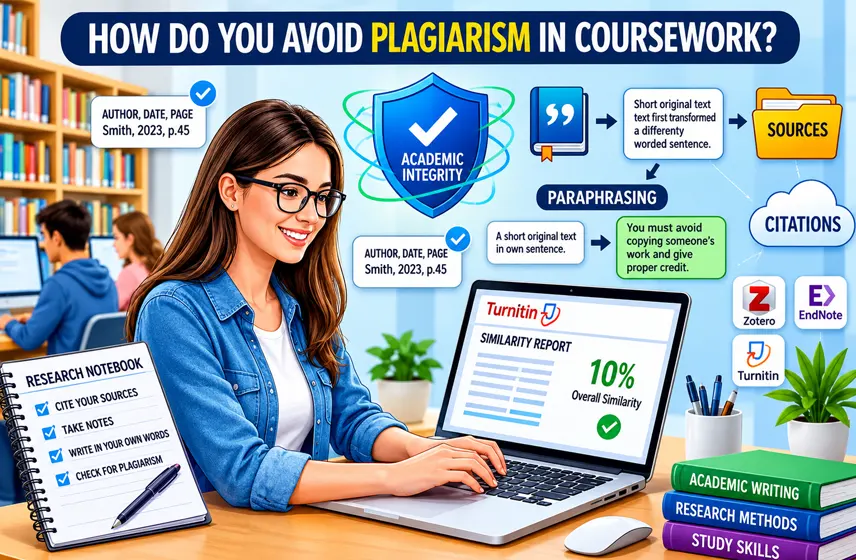
Plagiarism is presenting concepts or creations from another source as your own without giving explicit credit.
Plus, recycling your own previously produced material without proper attribution can likewise count as plagiarism.
According to examination rules, plagiarism committed purposely or through careless disregard constitutes a disciplinary violation.
Let’s put in another way, plagiarism is an act of fraud. Moreover, it means taking credit for another person's work while also being dishonest about it.
The University regards plagiarism and academic misconduct as serious matters. It has well-defined procedures for addressing such wrongdoing.
Although plagiarism is often deliberate, it can also arise from weak academic writing, sloppy note-taking, or faulty referencing.
That is why you must avoid plagiarism to maintain academic integrity. In this guide, I will explain practical tips to remove plagiarism from your coursework.
What is Plagiarism in University Coursework?
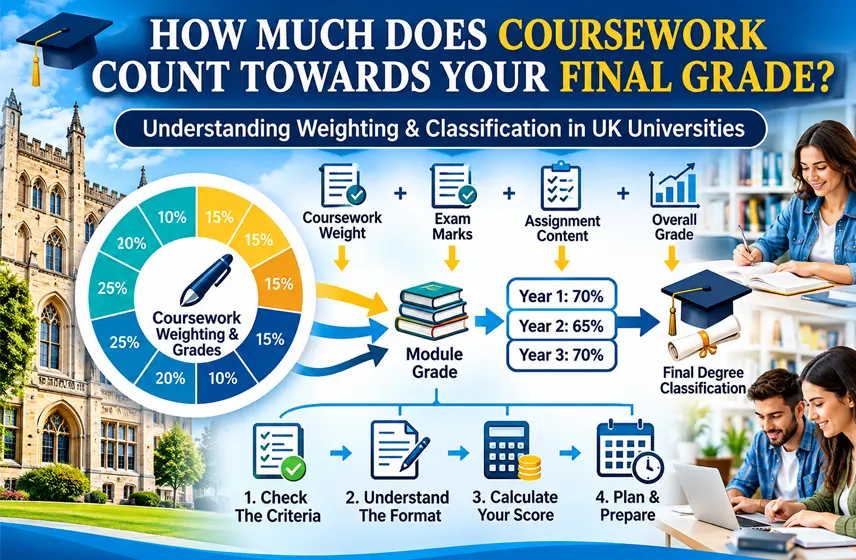
During their program, students usually encounter the term plagiarism as part of their school or university academic integrity rules. Understanding these rules is important because plagiarism can affect academic performance and coursework counts toward a student's final grade.
This term, plagiarism, could also appear in a course syllabus. Or your instructor or librarian may address it during a class meeting. Discussions of plagiarism typically use forceful language to stress how serious the offense is.
Merriam-Webster defines plagiarism as stealing and passing off (the ideas or words of another) as one's own, and committing literary theft by failing to credit or cite the source.
Types of Plagiarism
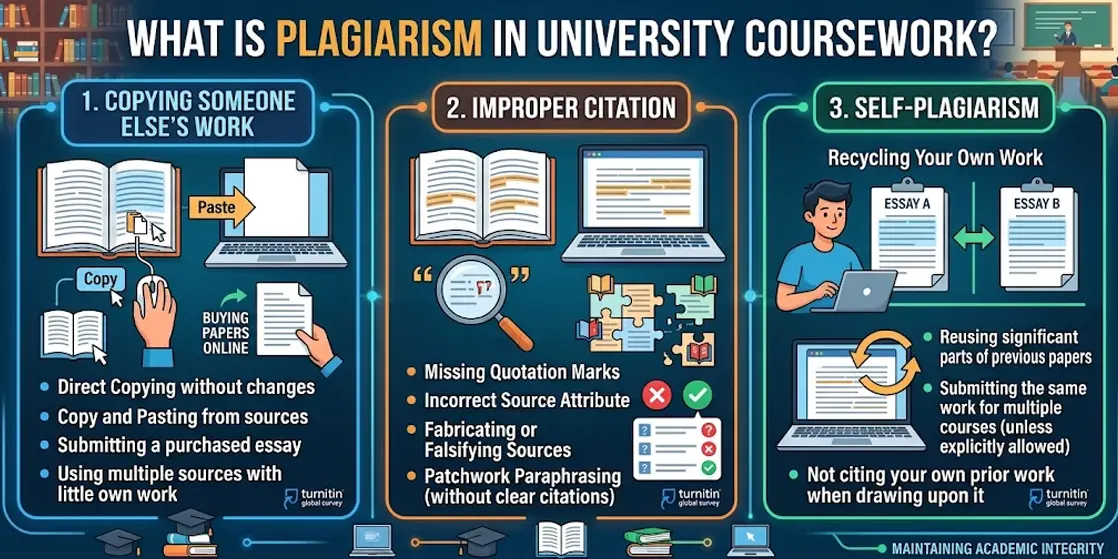
There are different kinds of plagiarism, but I point out the top 3 that are vital.
- Copying someone else's work: From copy-pasting to buying papers online is, per Turnitin's global survey, one of the most common and serious forms of coursework plagiarism. Turnitin listed multiple ways work can be copied. These include direct copying and various edits to copied passages.
- Improper citation: This plagiarism type comes in many forms. Like misusing quotation marks, stitching together paraphrases from several sources. Or citing non-existent sources or misstating them.
- Self-plagiarism: Despite common student belief, Turnitin says you can plagiarize yourself. For instance, drawing generously from (your own) previous work without citation. Or you are submitting a written paper for one class in another.
How to Avoid Accidental Plagiarism in Coursework?
You have to learn how to avoid plagiarism in coursework. So you can submit original content. For that, build a note system that separates source types and blocks plagiarism. And your success is guaranteed.
Also, try color-coding paraphrases from your own ideas. Or use symbols that flag what each note actually is.
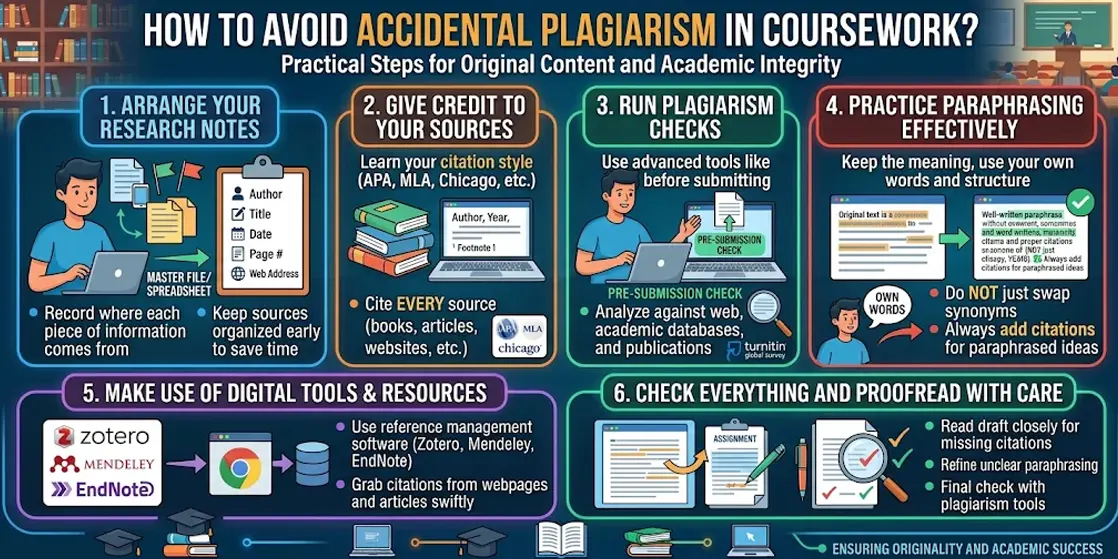
Here are the practical steps to avoid plagiarism in coursework.
1. Arrange your research notes
First, record where each piece of information comes from, including authors, titles, dates, page numbers, and web addresses.
Doing this early saves hours and avoids the agony of having great material you can't properly cite.
Plus, you can build one master file or spreadsheet that links each idea to its source. Others keep a separate file per source, then merge everything later with attribution built in.
2. Give credit to your sources
You need to learn the citation format your department or instructor prefers, such as APA, MLA, or Chicago. At times a style is assigned; at others, the choice is yours.
Whichever applies, cite every source: books, articles, websites, and anything else you draw on
3. Run Plagiarism Checks
There are many tools now to guard against accidental academic misconduct. Many options exist, but the most advanced plagiarism checker is Turnitin. The tool thoroughly analyzes your work in detail.
In addition, Turnitin goes beyond web-only comparisons by searching academic databases and publications to verify originality.
This lets you review your work before submission. Thus, you can avoid accidental breaches that might harm your academic career.
4. Practice paraphrasing effectively
Similar to any skill, paraphrasing takes practice, and it is an art. So, once you paraphrase another's work, keep the meaning intact but use your own words.
But remember, do not just swap a few words for synonyms, as that can still count as plagiarism. You have to use quotations, add citations, and, lastly, check and compare.
If you do not know how to check plagiarism in an assignment, you have to learn it.
5. Make Use of Digital Tools and Resources
You can as well use tech and software such as Zotero, Mendeley, or EndNote. These tools can be trusted to save and format your references swiftly and with no extra hassle.
Typically, these applications come with browser extensions that let you grab citation details straight from web pages and online articles.
6. Check Everything and Proofread with Care
Before handing in your content, go over the draft closely to catch any citations that are missing or paraphrasing that is unclear.
Remember that running your work through plagiarism checkers can help you spot places where you may have accidentally failed to cite sources correctly.
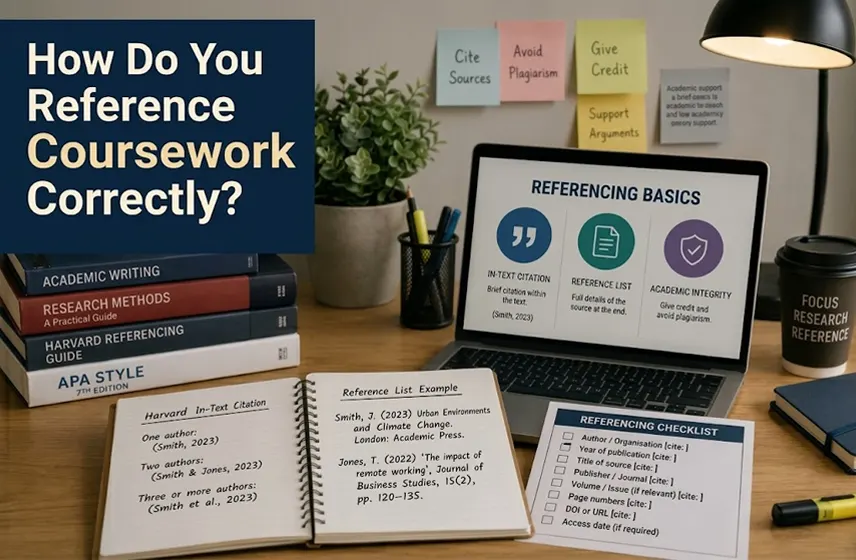
How to Cite Sources Correctly in Coursework?
Here are effective tips on how to reference sources correctly.
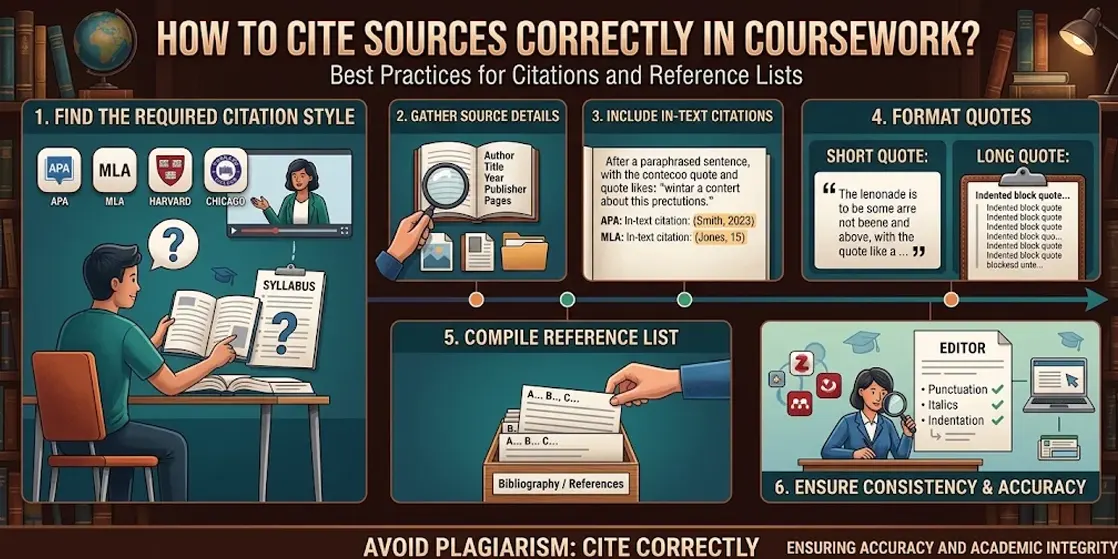
- Firstly, find out which citation style is required by checking your course book. Or you can ask your instructor about the specific formatting details (APA, MLA, Harvard, Chicago).
- While researching for your coursework, you should gather every detail concerning the source of the borrowed information. To do so, collect the required details: the author’s name, the publication title, the year it was published, the publisher, and the page numbers.
- To identify the author in the coursework, always include in-text citations after information that has been restated or quoted.
- Now treat short and long quotes differently when formatting: place short quotes within the text. Enclose them in quotation marks at the start and end.
- At the end of the coursework, compile a list of bibliographic references and list all the sources in alphabetical order.
- You must observe every rule for creating entries in a reference list and keep the format consistent across all entries (punctuation, italics, indentation, etc.).
- For guidance on less common situations, you can use reference managers or websites with special formatting guidelines. It is suggested by various educational institutions to avoid plagiarism.
What is an Acceptable Turnitin Similarity Score?
A satisfactory Turnitin score shows suitable citation practices and the level of overlap that fits the kind of assignment submitted.
Turnitin tests how similar texts are, and what counts as an acceptable percentage depends on the sources used, the formatting decisions made, and the instructor's directions.
For example, a lab report can justifiably show a higher degree of similarity than a reflective essay would.
Below is the general Turnitin Similarity score.
- 0% – 15%: Generally seen as low and perfectly normal for most standard papers that include proper citations and brief quotes. It means your paper will be accepted.
- 16% – 24%: Typically, this score is fine as long as the matches are scattered across a wide range of sources rather than clustered in one.
- 25% – 49%: This score is usually a yellow flag. However, it is high for a typical essay, yet it can be normal for literature reviews that pack with quotations.
- 50% and above: Ranging from high to critical risk; a strong sign of too much direct quoting, copy-pasting, or overlap with an earlier draft. This means your paper is at risk if it contains 50% or more plagiarism.
Conclusion
There is no doubt that avoiding plagiarism is of key importance in academics. Also, keeping academic integrity will help you complete a degree successfully. Students who need extra guidance can explore options to pay for coursework support while ensuring they understand their subject requirements.
By following the guidelines in this article, you can prepare coursework that avoids accidental similarities with existing sources.
So, create properly formatted research projects with paraphrased content. Adding an accurate reference list helps protect you from concerns about academic dishonesty.
Frequently Asked Questions
Q1: What is the difference between direct and self-plagiarism?
Direct plagiarism involves stealing someone else’s work and presenting it as one’s own. Self-plagiarism is resubmitting the same material as a new paper after you initially submitted it for publication.
Q2: How to paraphrase without plagiarism?
Read the source until you fully comprehend it, then set it aside and express the idea entirely from memory in your own language. Then use sentence structure, always with a citation.
Q3: Is zero percent on Turnitin desirable for coursework?
The ideal score on Turnitin depends on the specific requirements of the assignment. However, a score below 15% is generally acceptable. It indicates that no more than 15% of the paper’s content matches existing sources.
Q4: What is the difference between paraphrasing and direct quotes?
Paraphrasing means restating someone else’s ideas and information in one’s own words. Direct quotes use the exact wording from the source.
Q5: Can accidental plagiarism lead to sanctions at the university?
Universities take academic integrity seriously, and students can expect sanctions even if their plagiarism is unintentional.



 +44 7933 142807
 info@writemycoursework.co.uk

