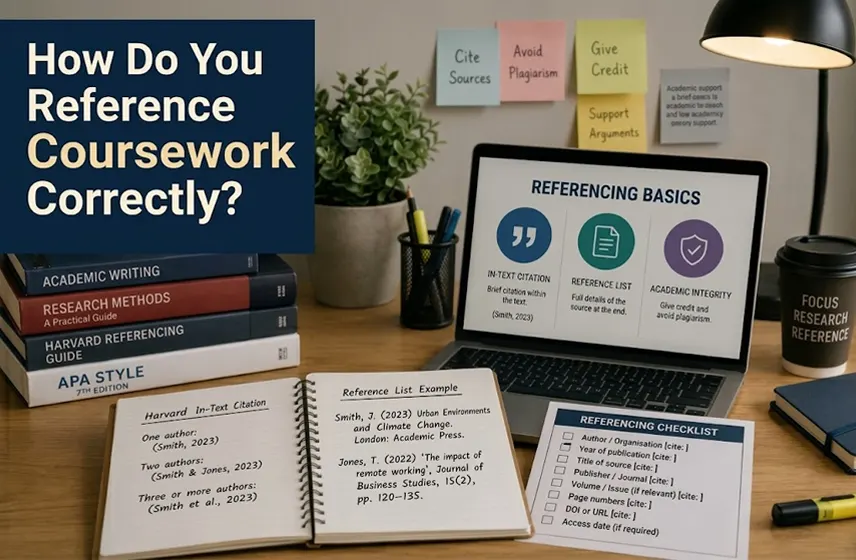
Have you ever finished writing your assignment and then stared at the reference list wondering, “Have I actually referenced all of it accurately?”
You’d never know the answer to this question unless you know the purpose of referencing in coursework. Angelil Carter found that many students approach referencing as a satisfactory institutional guideline which they have to fulfil anyway rather than seeing it as an aid to the development of arguments.
Well, referencing means giving credit to the original author for their ideas, words, or approaches that you have used in your coursework. It clearly shows the professor which idea is yours and where you have used someone else’s.
“Okay, but my assignment brief has words like in-text citations, reference list, reference styles. What’s that?” you ask. In-text citations are the markers within the main body of your writing to show readers whose idea it is, and include the name and publication year (e.g., Allison, 2019). A reference list is a complete catalogue of all the sources you have cited, and is included at the end of your paper. It has all the details, such as the author's name, publisher, page number, etc.
And before you think, “Oh, that does not look complex,” Wait. There are distinct referencing styles like Harvard and APA, and both work differently. They have different styles, official rules, and even variations used across UK universities. Effective referencing is another important aspect that helps in getting a first-class grade in coursework since it indicates academic honesty as well as gives you a chance to demonstrate your engagement with reliable sources.
Students, do not worry! This guide focuses on discussing everything about referencing: why referencing is important, how to reference different sources, the difference between APA and Harvard referencing, and much more is about to come!
What is Referencing in Education?
“Referencing is the practice of acknowledging in your own writing the work of others – work that has been presented in the public domain.” – Colin Neville.
If you are a UK university student or college student progressing to the higher academic levels, you are expected to become more critical of the ideas and theories you apply in your coursework. These ideas and theories are often taken from the public domain to support your argument.
Why is Referencing Important in Coursework?
Referencing accurately helps in showing your knowledge about the subject, protects you from plagiarism (we will discuss this later in this blog), and proves your argument.
Let’s suppose you write this claim in your coursework:
- Remote working opportunities have increased after the COVID-19 Pandemic
This claim sounds convincing, and you must have observed it too in practical life. But in academics, you need to show the proof of where these claims come from, to show that it is not mere observation, but that you have performed research on it.
There are several reasons to cite sources in coursework, such as:
- Giving credit: You acknowledge the researcher whose idea you have used,
- Supporting arguments: Academic claims make your writing more convincing,
- Showing well-researched content: References show that you have engaged with relevant and credible sources,
- Avoiding plagiarism: Proper citations save you from unintentional plagiarism, as it shows the reader which ideas belong to other authors,
- Strong academic integrity: UK institutions ask you to add references; students need to do it for the sake of the rules,
- Locating sources: Proper references help readers to locate sources and see where the argument comes from.
Important point:
Always focus on the difference between in-text citations and the reference list.
What is Harvard Referencing?
Harvard Referencing is one of the commonly used reference styles across UK universities, and is known for its simple functionality and clarity. It is an author-date system, which means that every time you use any external information in your writing, you need to add the author’s surname and the publication year.
The Anatomy of Harvard Referencing Style
The following are the two main parts of Harvard Referencing:
Harvard In-Text Citations
A Harvard in-text citation appears in brackets beside any paraphrase of a source or a quotation. As noted, it includes the last name of the author(s), the year of publication, as well as the page number or range locating the passage referenced.
Let’s look at some Harvard Referencing Examples for citations:
“The shift towards mobile-first content consumption reshaped how newsrooms prioritised visual assets during breaking news events.” (John, 2022, pp. 102-103).
Important point: Keep in mind that “p.” is used for a single page and “pp.” is used for multiple pages.
If the sentence already includes the name of the author, do not include it again in the citation.
For example:
- “Smith (2022, pp. 14-16) demonstrates that early adoption of visual storytelling techniques correlates directly with higher brand recall.”
Another example:
Harvard Reference List
A reference list is included at the end of your coursework. It lists all the sources you have cited in alphabetical order by the author’s surname, and also gives complete information about the source to the reader.
The Harvard reference list starts with the Author’s surname followed by their initials. The first word is capitalised in the reference, as well as any proper nouns.
Harvard Reference List Example
- Khan, M. 2023. Audience engagement and impression management on social platforms. Journal of Communication Studies, 15(2), pp. 45–60.
- Patel, R. and Jones, K. 2021. Strategic Public Relations and Community Building. 2nd edn. New York: Oxford University Press.
- Smith, J. 2022. Digital Visual Storytelling: Media Framing in the Modern Era. London: Routledge.
How to Cite Sources in Coursework?
You have seen the citation examples for one author. But how to cite sources in coursework comprising more than one author?
Let’s find out.
One Author
In case you struggled to understand the previous one-author example, let’s understand it with some more examples:
For paraphrasing: “Recent studies show that climate change accelerates urban heat island effects (Smith, 2023, p. 6).”
For a direct quote: According to Smith (2023, p. 6), “urban planning must adapt immediately to rising surface temperatures.”
For Reference List (book): Smith. J. (2023). Urban Environments and Climate Change. London: Academic Press.
Two Authors
If you are citing sources with two authors, the surnames of both authors must be listed in your in-text citation. Make sure to keep the placement of the names in the same order as they are in the source.
In-text citation: The study states that renewable energy adoption reduces urban emissions (Smith and John, 2023).
Reference List (journal article): Smith. J., and Jones, T. (2023). Evaluating urban solar adoption rates, Journal of Renewable Energy, 18(4), pp. 205-210.
Multiple Authors
If you are sourcing more than two authors, like four, five, or six, then you only list the surname of the first person attributed as one of the source’s authors in the in-text citation; the rest will be listed as “et al.”
In-text citation: Zheng et al. (2019) studied the change in productivity among Gen Z.
Reference List: The surname and initials of all authors are listed in the reference list.
- Zheng. A, Smith. W, Neville. A (2019) ‘Learning about the productivity change among Gen Z to improve workflow in corporate,’ Corporate Workflow Research, 19(3), pp. 332-387.
No Named Author
If sources do not identify an individual author, look for the organisation responsible for publishing it.
For example: (Department for Education, 2026) or (NHS, 2026).
How to Reference Different Sources
The best way to approach academic referencing is to look at the answers to these four questions:
- Who created the source?
- When was it published?
- What is it called?
- Where can it be found?
Also, there are different referencing formats used for different sources.
Let’s look at each source's referencing so you do not make any mistakes:
How to Reference a Book in Coursework
A Harvard reference for a book may include:
- Author
- Year
- Title
- Edition
- Publisher
- Publication details
For example:
- Wilson, J. (2024) Principles of Organisational Behaviour. 2nd edn. London: Example Publishing.
When you are researching, it is best to write down these details immediately before moving forward. It sounds like a small habit, but it saves a lot of time and reduces the chances of making mistakes in the reference.
How to Reference a Journal Article
While referencing journal articles, it usually requires:
- Author
- Year
- Article title
- Journal title
- Volume
- Issue
- Page range
- DOI, where required
For example:
- Khan, R. (2024) ‘Student engagement in online learning’, Journal of Higher Education Studies, 12(2), pp. 45–58.
Important point:
If you are working on a dissertation, ensure you keep these details organised from the beginning to avoid losing any important information.
How to Reference a Website in Coursework
When you are referencing a website in your coursework, you must look for:
- Author or organisation
- Publication/update date
- Website title
- Website details, where required
- URL
- Access date, where required
For example:
- University of Example (2025) Academic Writing Guide. Available at: website address (Accessed: 30 August 2026).
However, finding a webpage from Google does not automatically make it a suitable academic source.
So, before using it, ask:
- Who published it?
- Is the information current?
- Is the organisation credible?
- Does the page provide evidence?
How to Reference a Report
Reports are official documents that are often produced by governments, universities, charities, professional bodies, or organisations.
For example:
- Department for Education (2025) Education and Skills Report. London: Department for Education.
Make sure to check whether the report includes a report number, DOI, or URL and whether your university expects you to include it.
Harvard Referencing vs APA Referencing
Harvard and APA referencing may look similar at first glance because both use author-date citations. However, their formatting rules are different.
| Feature | Harvard Referencing |
APA Referencing |
| In-text citation format | Author name, Year (e.g., John, 2019) | Author name, Year (e.g., John, 2019, p. 3) |
| Page numbers in in-text citations | Usually not included, except for direct quotes or specific page references. | Always included for direct quotes or paraphrases. |
| Reference list format | Alphabetical by author’s last name. | Alphabetical by first author’s last name, then by subsequent authors’ last names. |
| Et al. usage | Used for more than two authors throughout the body. | Used for more than two authors after the first citation in the text. |
| Most commonly used in | Social sciences, Humanities, Law | Psychology, Education, Social Sciences. |
Here, the biggest thing to remember is that Harvard referencing can vary between universities, while APA is associated with a more formally defined publication style.
For example, an APA citation might appear as:
- (John 2019)
But the reference entry follows APA’s specific rules for elements such as titles, italics, punctuation and digital identifiers.
If your module requires APA, use APA referencing examples from your university or department rather than copying a Harvard reference and changing a few details.
How to Create a Reference List
When you have finished writing the content and are moving to create a reference list at the end of your coursework, you must record the following details for every source:
- Author
- Publication date
- Title
- Publisher or journal
- Volume and issue, if relevant
- Pages, where required
- DOI or URL
- Access date, if required
Reference List Example
- Ahmed, S. (2024) Leadership in Modern Organisations. London: Example Publishing.
- Brown, T. (2023) ‘Employee motivation and performance’, Business Studies Review, 8(2), pp. 22–35.
- University of Example (2025) Academic Skills Guide. Available at: website address (Accessed: 30 August 2026).
Important point:
It is suggested to review your institute’s own guide to check the Harvard referencing examples for formatting clarity.
Difference Between Reference List and Coursework Bibliography
A reference list contains all the sources you have cited in the coursework. On the other hand, a coursework bibliography may contain additional material you consulted during the research, depending on your institute’s requirements. You can include details that you have not cited in the content in the bibliography.
Common Coursework Referencing Mistakes
According to CiteMe, 25-54% of students make mistakes in references, including at least one formatting error, incorrect volume numbers, or misspelt author names.
If you are thinking about how to avoid referencing mistakes, protect yourself from being among these students, and identify the common errors beforehand:
- Missing citations: You use another individual’s idea but forget to acknowledge the source.
- Incorrect author details: A misspelt author name makes it harder to connect the in-text citation with the reference list.
- Wrong publication date: Always check the source publication date rather than struggling to find it at the end.
- Incomplete website references: Copying only the URL does not usually provide sufficient bibliographic information.
- Mixing styles: Using Harvard for one source and APA formatting for another creates an inconsistent reference list.
- Inconsistent punctuation: Minor formatting differences make your reference list unprofessional.
- Missing page numbers: Make sure to include page numbers of the source if it is required.
- Citation-reference mismatch: A source mentioned in the coursework should correspond to an entry in the reference list.
- Unused sources: Do not include every source you read in your final reference list if your university asks for a reference list containing cited sources only.
How Referencing Helps You Avoid Plagiarism
Presenting someone else’s ideas, thoughts, or words as your own without giving proper acknowledgement is called plagiarism.
This is why referencing should be an integral part of your writing process, not an afterthought.
Moving forward, have you ever heard of unintentional plagiarism? Students do not copy-paste the content intentionally, yet their work gets marked as plagiarism. This happens when you fail to cite sources properly. This usually stems from poor academic habits, lack of citation knowledge, or time management issues rather than a deliberate attempt to cheat.
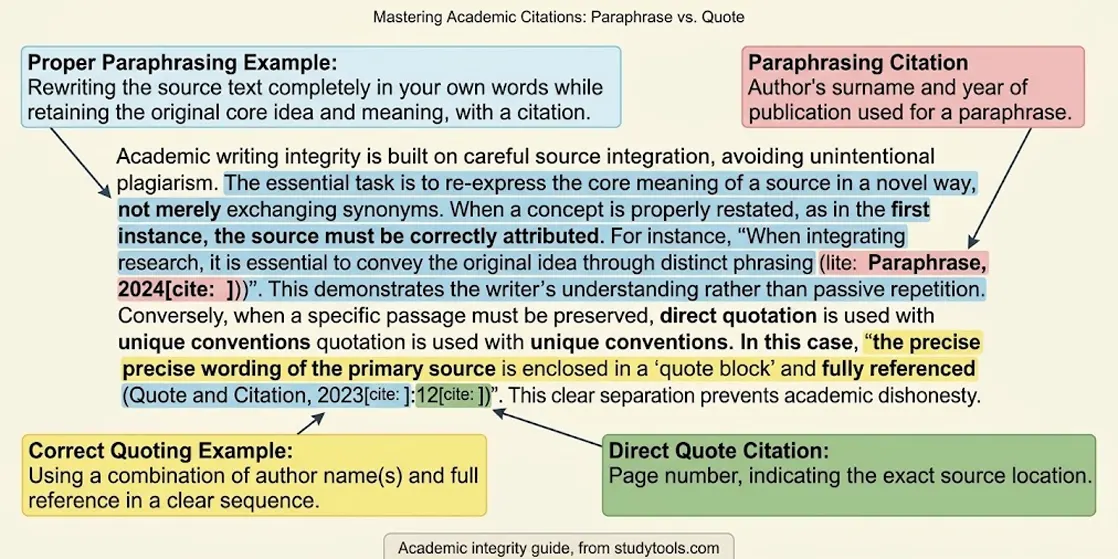
Many students think that using synonyms or restructuring the sentence means their content won’t be marked as plagiarism. But…
This is where you must know the difference between quotations and paraphrasing.
What is a Quotation?
Quoting means when you use the exact wording of the author in your content without making any changes. You then add the citation along with page numbers (if needed). Also, go through your university’s rules to avoid making any mistakes.
What is Paraphrasing?
Paraphrasing is the act of using someone else’s ideas or your own previously written texts in your own words while keeping the same meaning. Here, you change the vocabulary and sentence flow without adding any new detail to the original text. However, it is necessary to cite the source and give proper credit to the author.
References Tools Students Can Use
No, you do not have to do it all manually. There are numerous referencing tools available online that help you perform the task and save time.

Let’s find out the effective referencing tools you can use:
University Library Resources
Your university may provide a University Referencing Guide, databases, academic skills support, and referencing workshops.
Keep in mind that this should be your first port of call because it also reflects your university’s requirements.
Reference Management Software
Reference management tools help students and researchers collect, store, and organise source information while automatically generating accurate in-text citations and bibliographies. These tools are particularly useful for dissertations and heavy-work coursework.
The following are some of the top referencing tools you can use:
- Zotero
- Mendeley
- EndNote
- MyBib
- Scribbr
Citation Generators
Citation generators are online tools that automatically format bibliographic information into specific academic styles like Harvard, APA, MLA, Chicago, and other styles.
You simply put in an identifier – such as a website, URL, book ISBN, journal DOI, or title – and the software compiles the required in-text citations and reference entries.
Some of the best citation generators are:
- MyBib
- ZoteroBib
- Scribbr
- Quillbot
Word Processing Referencing Tools
Word processing referencing tools are built-in features or external software plug-ins that automatically format in-text citations and generate bibliographies.
These include:
- Microsoft Word References Tab.
- Google Docs Citation Tool
- Zotero
- Mendeley
- EndNote
Final Thoughts
When you first approach Harvard Referencing, it might feel like learning another academic task on top of researching, writing, and proofreading your coursework. But eventually, it becomes easier and a part of your research-based projects.
Make sure to record your source details as you conduct research, cite ideas immediately as you use them, keep your references list updated, and always check your final work against your institute’s requirements. If your course uses APA, follow its specific rules rather than mixing styles.
Most importantly, remember that referencing is not only about avoiding plagiarism or ticking a box for your professor. Good coursework referencing shows that you have researched your subject, engaged with existing academic work, and built your argument responsibly.
So, whether you are writing your first foundation-year assignment or completing postgraduate research, use your university's Referencing Guide; UK students are expected to follow it as your final authority. If you require additional assistance during the process, my coursework help will be able to assist you in learning about referencing guidelines and enhancing your academic writing skills. Once you develop the habit, accurate referencing becomes a natural part of confident academic writing.
Frequently Asked Questions
Q1: How do you reference coursework correctly?
To reference coursework correctly, you need to strictly follow the institution’s required referencing style (such as Harvard, APA, MLA, etc.) and ensure that every in-text citation has a matching entry in your final reference list.
Q2: What is Harvard Referencing?
Harvard referencing is a widely used academic citation style that relies on an author-date system to acknowledge sources within your writing. It helps you give credit to the original authors, support your own arguments, and prevent plagiarism.
Q3: What is the difference between Harvard and APA Referencing?
APA and Harvard are both author-date referencing systems, but APA has strict standardised rules controlled by the American Psychological Association, while Harvard is a flexible generic style with many local variations.
Q4: How do I cite a website in coursework?
To cite a website in your coursework, you need an in-text citation in the body of your paper and a full reference list in your reference list at the end. For in-text citations, include the author’s surname or organisation, and year (e.g., World Health Organisation, 2024). For a reference list entry, include the author's surname, Initial. (Year), Title of the web page. Available at: URL (Accessed: Day Month Year).
Q5: Do all coursework sources need to be in the reference list?
Yes, every source you cite or mention in your coursework must be included in the reference list.
Q6: How does referencing help avoid plagiarism?
Referencing helps avoid plagiarism by clearly separating your original ideas from the outside thoughts, data, or concepts you use.




 +44 7933 142807
 info@writemycoursework.co.uk

