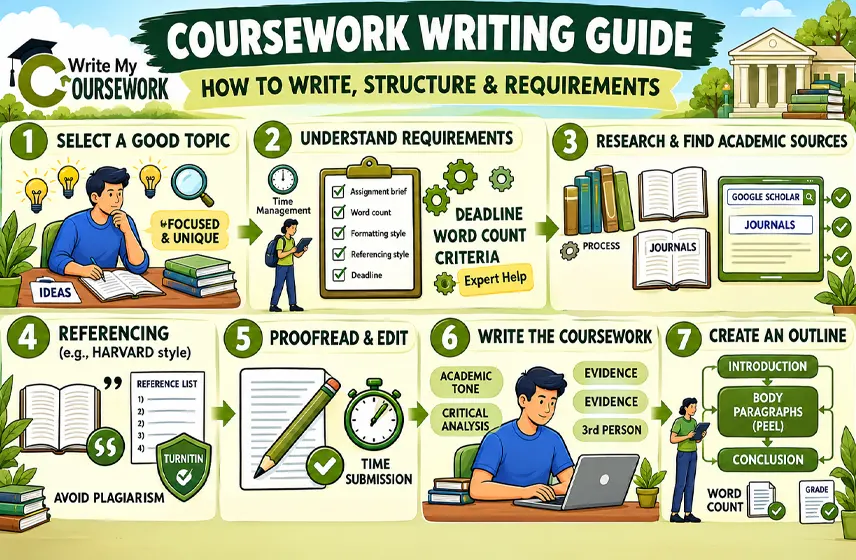
Coursework refers to any graded academic work that learners complete over the duration of the course as part of their overall evaluation. According to the Harvard referencing guide, coursework includes lecture notes, tutorials, handouts, or even work done in a virtual learning environment.
College life sounds thrilling and exciting, but it also comes with challenges. When deadlines start stacking up, one coursework assignment turns into 3.
On the other hand, group projects usually take longer. All of a sudden, learners who were once organised in writing assignments then missed deadlines, slept less, and had a hard time keeping up with academic duties.
That is precisely why students need to grasp the perks of writing coursework for strong time management. Since coursework is not about grades, a coursework writing guide teaches students how to focus on tasks, build productive habits, and handle pressure, helping them develop skills.
Coursework writing matters in UK colleges since it requires strong critical thinking and practical research skills. And as well as continuous development instead of only memorising for exams.
In this guide, I will talk about how to write coursework that meets the coursework requirements. So, let’s begin the article.
What is Coursework?
Coursework is written or practical work given to students to assess their knowledge beyond exams. In layman's terms, it is a kind of paper that requires you to complete a course.
Moreover, it covers every level of education, from high school to a PhD.
The aim of a coursework writing guide is far more than a requirement for learners to complete during a semester.
It is an evaluation method designed to assess learning as it develops over time, offering tutors a broader and more precise picture of learners' understanding, abilities, and academic development than a single exam can provide.
There are many types of coursework, from written assignments to lab reports to fieldwork. Lastly, coursework is vital for UK students because it helps them develop skills such as critical thinking, research skills, and creativity.
Types of Coursework Students Complete
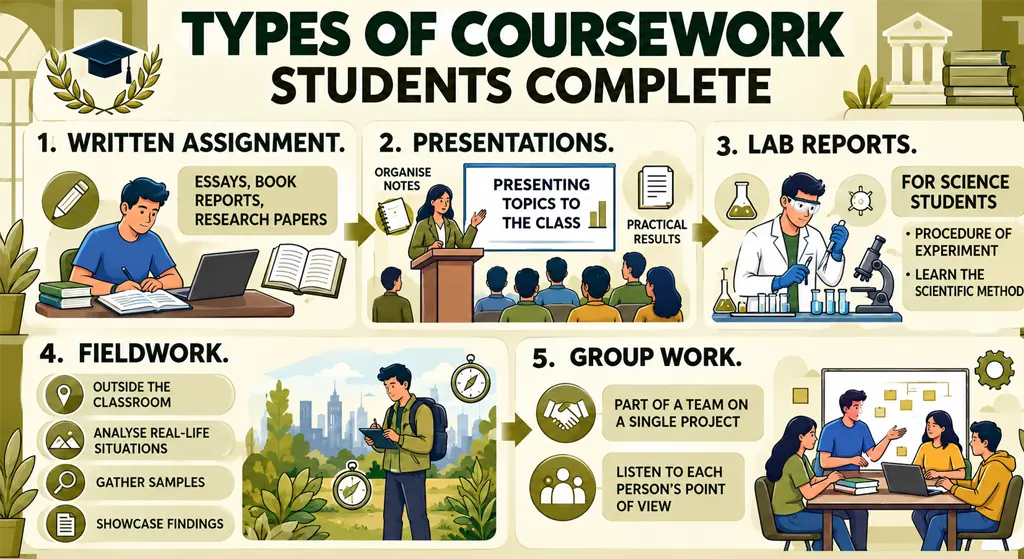
Here are the different types of coursework that students need to complete.
- Written assignment: It is among the most common kinds of coursework assigned to students; it can take the form of essays, book reports, or research papers.
- Presentations: Students are required to present their topics to the class. Moreover, it helps them organise their notes and produce practical results.
- Lab reports: for science students. In this report, students need to describe in detail the procedure of the experiment they conducted. In addition, by writing lab reports, students learn the scientific method.
- Fieldwork: Students may be required to go outside the classroom to analyse real-life situations. For that, they have to gather samples, create outlines, and then showcase their findings.
- Group work: Lastly, in a group project, every student is required to work as part of a team on a single project. It helps them listen to each person's point of view.
Why UK Universities Use Coursework?
In UK higher education, UK coursework goes far beyond memorisation abilities in order to examine a learner's skill to introduce and debate original ideas and answers.
In contrast to exams that primarily assess understanding and speed, which require students to finish within a set deadline, coursework aims for depth and extensive knowledge.
You need to learn how to write coursework for university.
Why is a Coursework Writing Guide Important in UK Universities?
Every student who is studying at a UK university is tired of writing too many assignments. Once they are tired, they mostly see a blank screen. But a coursework writing guide is vital for every UK student.
Because coursework is not just any assignment, it helps students develop skills such as critical thinking, written communication, and time management.
Here are the key reasons why coursework is essential for UK learners.
- Academic Assessment: Coursework provides a continuous measure of learners' progress and understanding in each module, rather than relying on a single exam.
- Skill growth: Learners improve their time management, writing, and online learning after they finish longer assignments.
- Independent learning: It motivates learners to handle their own timetables, so they can study freely. And hence, they take possession of their development.
- Research ability: A coursework writing task educates you on how to find, choose, and cite trustworthy academic sources, instead of depending on simple internet searches.
- Critical thinking: A coursework challenge that requires students to assess evidence and create balanced statements. They can create original conclusions.
- Professional preparation: Lastly, coursework prepares students for the real world where they need to write reports, analyse and examine case studies and craft a deliverable presentation.
Coursework Percentage
- The percentage of coursework varies widely across universities, departments, and specific modules.
- Fields such as humanities and arts depend strongly on coursework. From time to time, accounting for 50% to 100% of a module's final grade.
- In fields like STEM or subjects that rely on theory, coursework may range from 20% to 50%. On the flip side, exams hold the remaining balance.
How to write Coursework step by step?
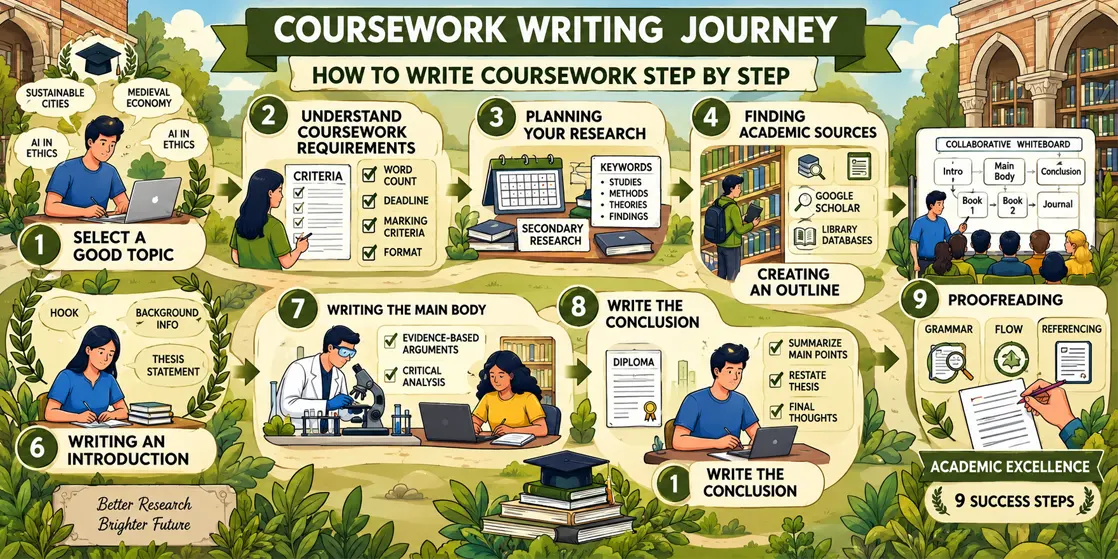
Here are the step by step by step tips for crafting a good and well-researched coursework writing guide.
You need to learn how to Write Coursework before writing. Follow these beneficial coursework guidelines.
1. Select a good topic
Choosing a tight topic or theme is vital to writing good and engaging coursework. Always choose a topic you are interested in and knowledgeable about.
Plus, a topic must be supported by your course aims. Here are the key steps to select a topic.
- Avoid selecting a broad spectrum— you need to concentrate your selection on something you can investigate and research carefully and in detail. But you have to obey the time limit you are given.
- Try covering things from a unique perspective. You can stand out by choosing a topic with a unique point of view. For that, you have to think about framing and writing a similar subject from a unique point of view.
- Keep a balance between selecting a subject and liking the journey. You have to ensure you choose a topic with plenty of available information.
Example: Let’s suppose you are studying environmental science and choosing a coursework topic.
- Bad and broad topic: Topics like global warming and pollution. This topic is vast and has plenty of info you need to cover in a short coursework.
- Good and focused topic: The influence of single-use plastic bans on local grocery store waste in London for the duration of the past 2 years.
2. Understanding Coursework Requirements
A diverse range of UK students just skipped the coursework requirements. It is the costliest error they make, and hence they are unable to get a score, even if their assignments are well-crafted, neat, well-researched, and carefully proofread.
However, they fail to grasp the requirements that tutors want. So take your time and follow these requirements for your assignment.
- Carefully examine the guidelines, marking rubric, coursework marking criteria, word count, structure, deadline, and the word count limit.
- Spot command words. Now you have to look for words such as debate, assess, or contrast to understand what action you need to take.
- Example: If the prompt asks you to evaluate the influence of social media on teen sleep. You should write the pros and cons. And do not just define social media use.
3. Planning your Research
Once you choose a good topic and understand your assignment requirements, you need to plan your research.
A solid research question offers your coursework a clear and good direction. Also, it assists you in choosing which info is pertinent throughout the research phase.
Here are effective methods for conducting research for coursework.
- To begin with, you need to leverage journals, books, and official publications for data gathering. And do not rely only on random internet papers for coursework assignments.
- Access and weigh the source with the help of the author’s credentials, date of publication, and peer review status.
- Lastly, you need to recap every finding with plain references to save time for the duration of the writing phase.
4. Finding Academic Sources
To find credible academic sources, follow these steps.
- Describe your keywords- jot down particular words and phrases about your topic before you can start finding
- Leverage academic search engines. Now type your keywords into a search engine like Google Scholar to find peer-reviewed papers and research papers.
- Search specialised databases— you need to leverage particular tools such as PubMed for medicine or IEEE Xplore for engineering.
- Examine your school library. You can log in to your university portal library to access paid journals, academic books, and physical records.
- Look at the reference lists. Lastly, open a valuable book or even an article to read its bibliography to find more pertinent sources.
5. Creating an Outline
A clear coursework structure will make your paper simple to read, and you must make sure that your arguments flow smoothly from one section to another.
Standard coursework follows the 4 sections, like the introduction, body, and conclusion. Here are the tips on how to structure coursework.
- In the intro, you have to introduce your topic, write a strong thesis statement, and then mention the key objective
- In the body section, split it into sections with subheadings that clarify the points methodically.
- Lastly, write a concise conclusion that recaps your main points and outlines future recommendations.
6. Writing an Introduction
It is essential to understand how to write an introduction to coursework. The primary aim of a coursework intro is to capture readers' attention with an engaging hook.
Here are the effective methods of writing a good introduction.
- Begin with a short story
- Using statistical data
- Begin facts
- Or use a thought-provoking question
7. Writing the main body
In the body section, you need to introduce all pertinent data as well as facts. The body section is vital, where students clarify every paragraph or idea in depth.
In the body section, the PEEL structure can work effectively: Point, Evidence, Explanation, and Link.
So, you need to make your point, provide evidence, and then support it. Moreover, clarify what the meaning of evidence is in the argument setting, and lastly, connect back to the question or your broader thesis.
8. Write the Conclusion
Lastly, in the conclusion, uniquely restate your thesis statement. Do not add new info in the conclusion section; it will confuse your readers.
Rather, you need to pull your argument and explain its significance.
9. Proofreading
Finally, once you have finished writing a piece of coursework, do not submit it yet; you need to proofread it wisely. Because typos, awkward phrasing, or a lot of grammatical mistakes can steal your grades.
Even if it is well-written and you researched it well from credible sources. So, take some time and rest for at least 1 day before proofreading.
You need to make sure you have plenty of time for a coursework submission. Here are the effective coursework proofreading techniques you can use to proofread your coursework.
- Basic sense: Make sure that you have written a paper in a basic form and that it makes sense. Then analyse if the sentences are inconsistent, and if they are, do not fail to notify the reason for the same.
- Before submitting, you need to double-check the word count.
- The last stage of your coursework: In the last stage of your coursework, the grammar and punctuation you need to use. By doing so, your sentences will be proper, without any mistakes or typos, and with proper punctuation.
- Formatting: Lastly, ensure you format your coursework according to your tutors' requirements. A coursework format must include all of the page numbers, font sizes, and line spacing, which are correctly maintained. For citing sources, use a Harvard referencing style to avoid Plagiarism.
Best Coursework Writing Tips
Here are the best coursework writing tips and how to improve coursework grades.
- Time Management: First, break down your coursework into small, daily tasks. Then create a personal deadline two days before the actual deadline to leave time and avoid sudden delays.
- Reading assessment criteria: For coursework assessment criteria, carefully read your tutor’s grading rubric first. Then you have to match all sections wisely and try to understand what the tutor wants.
- Writing Academically: 3rd-person. Your writing must be formal, use 3rd-person language, and maintain a professional tone. Do not use any slang contractions such as don’t or any personal points of view like I think or I believe. Rather than write, investigate or discuss.
- Avoid repetition: Every sentence or paragraph of your coursework must start with a new idea. Do not repeat ideas or points.
- Evidence-based Arguments: You have to support your claims and add relevant citations with solid facts, data, and quotes. Plus, you have to cite your source every time so readers know your evidence is real. For research and to add citations, connect with a professional at Coursework Help UK. These services work with certified and experienced PhD writers who will teach you step by step.
- Critical Analysis: Do not only mention evidence or proof; you need to think critically, question your sources, and search for hidden weaknesses. And lastly, clarify why your findings matter.
- Structure: From intro to middle to end, structure your work using the PEEL method.
- Grammar: Examine your sentences carefully for proper verb sentences and punctuation. In order to catch words and awkward phrasing, you need to read it aloud.
- Editing: Lastly, before you edit, you need to rest for at least 1 day. Then return with a fresh eye to edit your work.
Understanding Coursework Marking Criteria
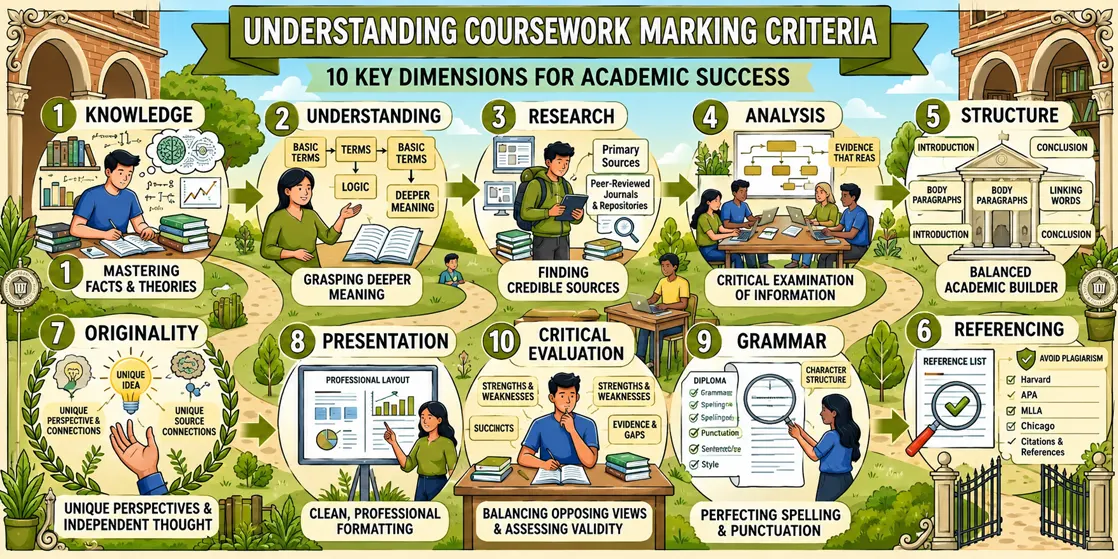
Coursework writing in UK universities typically upholds first-class standards that showcase deep insight, flawless execution, and independent thought.
1. Knowledge
Your knowledge displays that you have a detailed, complete, and precise command of facts, theories, and all terms.
2. Understanding
Your understanding of the topic reveals deep insight rather than surface-level learning. And once you have a good understanding, you can easily clarify hard ideas with total clarity.
3. Research
To write quality, original coursework, your research must be extensive, highly relevant, and draw on both primary and secondary academic sources.
4. Analysis
For analysis, break down tricky data or arguments carefully. You need to go far beyond simple description to investigate principal meanings.
5. Structure
Your structure must follow a logical, perfect, and engaging narrative, and every paragraph must be connected to the others. And start with a new one.
6. Referencing
Your referencing must be accurately applied with total precision and consistency throughout the text and bibliography.
7. Originality
Your ideas must be original with unique points of view, independent insights, or creative connections. And you have to go far beyond the standard lecture notes.
8. Presentation
Your presentation must include a refined, professional outline. And you have to follow every formatting and guideline requirement strictly.
9. Grammar
To write your coursework perfectly and flawlessly, leverage perfect spelling, accurate punctuation, and a professional academic tone.
10. Critical Evaluation
Lastly, you need to weigh up opposing arguments fairly and see the limitations in the present work. After that, create a solid and well-supported personal verdict.
How Much Does Coursework Count Towards Your Final Grade?
Coursework writing guide generally counts for somewhere in the range of Coursework Percentage of 20% to 100% of your final grade. But the precise impact or influence typically relies on your particular university, department, and country.
Below are the common coursework weighting examples.
- 20 to 30% (low weighting)- This generally indicates a single mid-term essay, a lab report, or a series of weekly quizzes. However, the remaining 70% to 80% of your grade is based entirely on a critical last exam.
- 40% to 50% (Balanced method) - This makes an equal split between continuous evaluation and formal exams. Let's suppose you have 2 huge essays, each worth around 25%. After that, it is followed by a final exam of 50%.
- 60% (high weighting) - In this situation, your coursework carries more weight than the final exam. This format, which gives more weight to assignments, offers greater benefits to students who perform very well during the semester.
- 100% (complete coursework-based)- This approach reduces traditional exams entirely. This approach is commonly used in practical qualifications that do not involve exams. Students' assessments are based on portfolios, longer essays, assignments, and group projects.
Harvard Referencing Explained
1. What is Harvard referencing?
The roots and origins of Harvard referencing, which is an author-date citation style, are intriguing. At the end of the 19th century, a zoologist, Edward Laurens Mark, presented an initial version of the author-date system.
Edward was the Director of the Harvard Zoological Lab during that time. In addition, the Harvard style comprises two parts: in-text citations and a reference list.
It also credits the original authors of the articles.
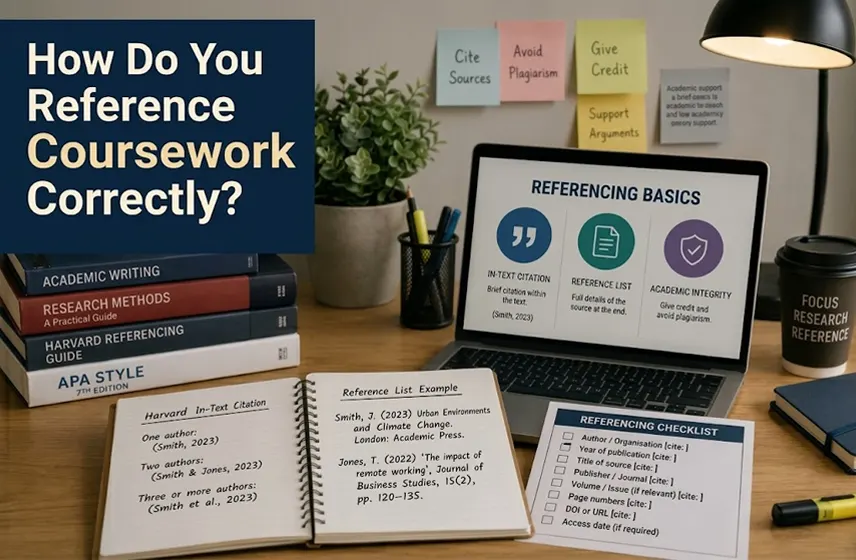
2. In-text citations
In-text citations are generally placed in the text next to a quote or paraphrase. Plus, it showcases the author’s last name and the publication year.
Example (Author-focused): Smith (2022) discovers that.
Example (Date-focused): Present data displays this trend (Smith, 2022). A page number for direct quotes: (Smith, 2022, p. 47).
3. Reference list
The reference list is generally placed at the end of the coursework on a new page. A reference list is usually arranged in alphabetical order, followed by the author's last name in Harvard referencing.
In addition, it adds complete details of publication for every source employed in your text.
4. Books
Books commonly used in the Harvard style follow this pattern.
- Format: Author surname, initial (S), (Year) Book Title. Edition, then Place of publication: Publisher
- Example: Smith, J. (2019). Understanding economics. 2nd edn. New York: Pearson
5. Journals
- Format: Author Surname, Initial(s). (Year) 'Article title', Journal Name, Volume(Issue), page numbers.
- Example: Brown, A. (2020) 'Climate change impacts', Environmental Science, 14(2), pp. 110-125.
6. Websites
Here is the style of Harvard referencing used in Websites.
- Format: Author of Organisation (year) webpage title accessible at: URL accessed day month year)
- Example: World Health Organisation (2021) health guideline, accessible at accessed 15 May 2026
7. Common Mistakes
Here are the common mistakes students generally make in Harvard referencing style.
- Missing brackets or using wrong punctuation in citations
- They overlook adding page numbers for direct quotes.
- Adding and listing sources in the reference list that do not turn up in the paper.
- Lastly, the majority of the students mix up the order of the author’s name and initials.
8. Referencing Tools
For adding references, you can leverage online digital manager tools like Zotero, Mendeley, or EndNote to automatically gather sources and structure and format your reference list and in-text citations properly.
Can AI be used for Coursework?
Thinking about whether you use AI for coursework? Yes, you can certainly use coursework; there are plenty of free tools to help you write quality, compelling coursework.
- ChatGPT: It is best for clarifying complex concepts, conducting in-depth research, and simplifying hard-to-read texts. And it can even help you practice quiz questions.
- Gemini: Gemini is best for looking up current information and reviewing web papers. And as well as structuring study notes.
- Claude: Claude is best for reading longer content and for clear, well-written responses. Moreover, Claude will assist with in-depth, thoughtful clarifications.
- Microsoft Copilot: Lastly, Microsoft Copilot is useful for integration with MS Office. It offers the best web with citations and helps students to plan group projects.
Responsible AI Use
Here are the effective suggestions for using AI in coursework.
- Check school rules: you need to follow your school's or tutor's particular policy on AI tools before using.
- Treat AI like a tutor: you can also ask the AI to teach or clarify instead of copying and pasting the whole work.
- Verify info: remember, like humans, AI can make errors or mistakes or add false evidence. You have to check facts or evidence every time before you use trusted books or websites.
- Maintain your voice: Lastly, coursework should reveal your own ideas, understanding, and effort.
Can AI help with these Tasks?
- Brainstorming: Sure, without doubt, AI can now help brainstorm ideas, suggest topics, and viewpoints. Or help you project ideas when you're stuck.
- Planning: Indeed, AI can also create a study timetable or break huge tasks into smaller weekly steps.
- Grammar: Tools like Grammarly can spot mistakes when humans cannot spot them and even suggest ways to fix awkward sentences.
- Summaries: AI can also shorten long paragraphs and offer digestible summaries that are easy to read.
- Outlines: Lastly, AI can also assist students in structuring and organising their ideas from intro to body to conclusion.
What you must never do
Here are the key things you should never do while using AI in university coursework.
- Never copy AI text: Well, if you copy and paste whole paragraphs or even pages at the same time, your article constitutes plagiarism.
- Never submit AI work: without adding any value, your ideas or thoughts, or editing- and written entirely by the AI can break the academic honesty rules.
- Never fake references: Most of the time, AI creates false book titles, studies, or web links. So, always verify your sources before adding them to your coursework.
How to Avoid Plagiarism
Here are effective tips to avoid plagiarism in academic coursework and academic writing.
- What plagiarism is: It is basically academic theft, copying text from someone else's articles or stealing data. And not giving the original author any credit.
- Self-plagiarism: Self-plagiarism occurs when you again use your own past papers or essays for new class assignments. For that, you have to ask your teacher first every time or add references to your previous work.
- AI plagiarism: AI plagiarism is when students submit essays, answers, or even code generated by AI. And you do not even prefer your own work. Treat AI only as your assistant; it is here to help you.
- Quoting: To avoid plagiarism, you need to use direct quotes only when the precise and similar words are essential. Also, you can place similar words in quotation marks and then use a quick citation by using the name of the author and the page number.
- Paraphrasing: Paraphrasing implies restating the original text in a different way after reading it. And changing the sentence structure and words. However, it is still regarded as plagiarism; you still need to add a citation of the source once you have done the paraphrasing.
- Referencing properly: To avoid plagiarism, use a formal style of citation like APA, MLA, or even Chicago.
- Turnitin: To scan learners’ papers against a huge global database of books, journals, and websites, universities use advanced software like Turnitin. Once you're done writing your coursework, you need to check your content in Turnitin.
- Best practices to remain safe: Lastly, you need to begin writing your work early, maintain a clean list of each source you read, and wisely paraphrase with citations. Then investigate your work before submitting it.
When Should Students Get Coursework Help?
Once you are having a hard time with coursework or are unable to write it ethically, use an expert coursework help UK brand.
Here are effective tips for using support.
- Difficult subjects: When you face hard subjects or do not have any clarification, you can look for tutoring or support.
- Tight deadlines: When you run out of time, need time management guidance, or have a busy work schedule, you can obtain support from experts.
- Editing: Once you're done writing your coursework, you can request editing to improve flow, clarity, and logical argument structure.
- Proofreading: Approach and get support from professionals to proofread your content, such as catching spelling, grammar, or punctuation errors.
- Referencing: You can get support with formatting citations and bibliographies to ensure your work is original.
- Feedback: You can ask the expert tutors for a positive review to help you develop your writing and research skills. So that in the future you can write assignments by yourself.
- Academic Support: Lastly, you can obtain guidance once you plan your research direction, grasp assignment rubrics, or have trouble understanding the requirements.
Conclusion
As a result, by using our detailed coursework writing guide, you will surely nail your coursework assignments.
Remember, coursework writing needs extensive planning, good research, strong academic writing skills, and proper formatting.
You have to plan well before writing, use credible academic sources, and perform research carefully. After that, you need to verify your sources and write in a 3rd person, using a professional tone and easy-to-read words.
Moreover, do not use any personal biases, and lastly, format your paper using the Harvard referencing style.
Well, if the need arises, like you are under tough deadlines, have busy schedules, or are facing writer's block, an experienced and seasoned Coursework Help UK comes in handy.
Only use it as an assistant and learning tool.
Frequently Asked Questions
Q1: What is coursework?
A course is an academic task that is typically completed over a semester, rather than a single page.
Q2: How do I write coursework?
To write coursework, you need to choose a good topic, research it using reputable sources, outline and structure it, add the final formatting with citations like APA or Harvard, and proofread it carefully.
Q3: How long should coursework be?
The word count of coursework writing depends on factors such as specific academic guidelines and the academic level. And the tutor’s instructions.
Q4: How much does coursework count?
The weight of the coursework normally depends on your study level and the particular subject. It ranges from 0% in exam-heavy focus subjects to 100% practical qualifications.
Q5: Can I use AI for coursework?
Yes, you can surely use AI in your coursework. Before using AI, you need to check out the guidelines of your university and policies carefully.
Q6: What is Harvard Referencing?
The Harvard referencing style is a kind of international citation format, and it is used in academic papers. The main aim of Harvard referencing is academic integrity and honesty.




 +44 7933 142807
 info@writemycoursework.co.uk

