
A first-class coursework grade is built through clear thinking, purposeful research, and critical academic writing.
“AI will become so much cheaper that only the rich will be able to think on their own.”
I crossed my eyes with this quote recently, and I could not agree more. AI has made its place in almost every field, including Education, and every other student (in some way or another) depends on AI tools in their coursework.
According to a survey report by The Guardian, 66% of secondary school teachers in England state that students who use AI are losing problem-solving and writing skills. And honestly, AI does not do anything more than answer your question (no critical thinking).
So, if you are a student aiming to achieve a first-class grade in your coursework, you need to do more than just answer the question.
Most college students lose marks because they do not describe information without analysing it, use weak sources for research, overlook the marking criteria, or submit their weeks or months of writing without proofreading (the most frustrating reason for me).
So, good coursework writing tips can help you avoid these problems by giving you a systematic way to approach your assignment. From understanding the command words to finding credible evidence, developing strong arguments, and checking the references, every stage contributes to earning a first-class coursework grade.
If your goal is to improve coursework or get exceptional academic writing tips for higher grades, stay with us till the end of this guide. We will also look at some examples and a checklist!
What Does First-Class Coursework Look Like?
As a Lecturer in the Marketing Department at a renowned UK university, I have observed that first-year students lack the skills and knowledge to write an assignment.
I assigned the class to write an essay on the Impact of Social Media on Modern Journalism. And a bulk of the assignments were based on the definitions of social media and journalism. I was shocked and disappointed at the same time.
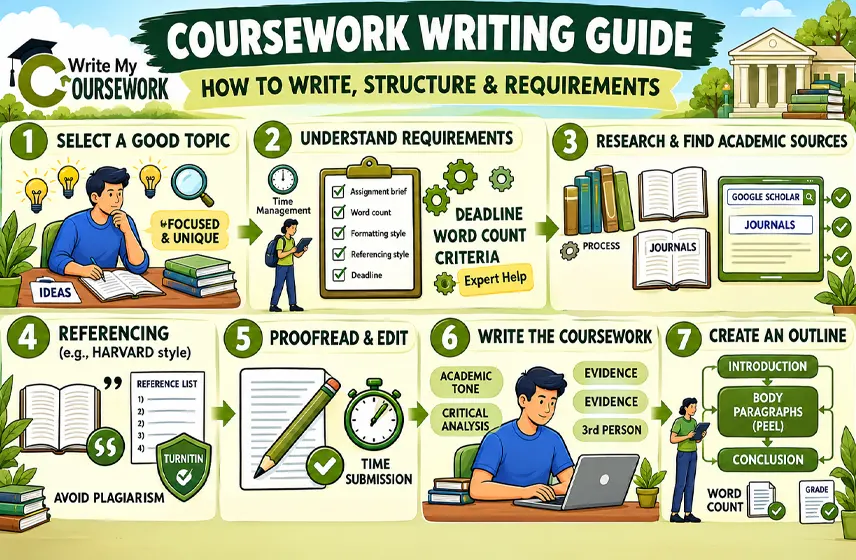
So, college students first need to understand what good coursework looks like, what it includes, and what to avoid. Although the grading criteria depend on the subject matter, assessment criteria, and institutions, the following are the first-class coursework requirements:
- A clear understanding of the question and subject (spend sufficient time to understand before writing).
- Relevant and credible academic research using sources like Google Scholar or JSTOR.
- Critical analysis that evaluates opposing scholarly arguments, questions underlying assumptions, and develops an independent, well-justified argument.
- Application of evidence that fulfils the purpose and supports your arguments.
- A logical and coherent argument that ensures every point links to your main idea.
- Well-organised paragraphs and structure (the professor won’t try to connect the dots on your unstructured content).
- Ensure accurate referencing (read the criteria to check the required referencing style, like APA, MPA, etc.).
- Professional presentation of your work.
Understand the Coursework Question First
Professors are not going to judge you if you submit your assignment before the deadline (no, there are no extra marks for it). But they are definitely going to give poor remarks if you do not answer what’s asked of you.
On that note, here comes the most overlooked coursework writing tip: understand what you have been asked for.
Read the assignment brief multiple times before researching. In addition, look for command words like analyse, evaluate, describe, compare, reflect, critically assess, or examine. These words tell you what kind of response is expected.
For example, if I ask my students to evaluate the AIDA model, then I am not looking for a mere description of the theory. Students need to consider its value, limitations, supporting evidence, and alternative perspectives.
Also check the coursework marking criteria, including:
- The required word count,
- Learning outcomes,
- Assessment instructions,
- Submission requirements,
- Referencing style.
Important point:
Another benefit of knowing the marking rubric is that it helps to create an outline and plan your entire assignment at once. For example, if critical analysis carries more marks, then your assignment should be more focused on the critical analysis.
Use Strong Academic Research
Once a student supports their argument with a… FORUM.
“A forum? Is that any new research method which I am not aware of?”, I asked that student.
Well, the meaning of research is to gather relevant and credible data from books, journals, reputable articles, research papers, and institutes’ databases. Where appropriate, prioritise recent studies, particularly for subjects where research and professional practice change quickly (e.g., Nursing).
The following are some incredible coursework research tips for college students:
- Write down your main research question and key search words.
- Combine your search words with words like “AND” or “OR” to find better results.
- Make sure to evaluate the sources by checking who wrote the text, looking for facts supported by evidence, and seeing if the author has bias or an agenda. You can also use the CRAAP Test as a practical framework for evaluating sources.
- Skim through the content to see if the source is useful.
- Write down the quotes and ideas, and also record the author, date, and title to keep track of citations.
- Group your notes and ENSURE TO WRITE THE CONTENT IN YOUR OWN WORDS.
Build a Strong Coursework Structure
A well-organised structure makes it easier for the assessor to follow. It usually contains three main sections, which are:
Introduction
Be it writer’s block, first-sentence anxiety, or the art of describing what the essay is about – these are some of the aspects which make writing an introduction the most tedious section.
The purpose of an introduction is to cover what your topic is, what its central arguments are, and how you are going to approach them in your writing.
Want to know a first-class academic writing tip for writing an introduction?
Here it is:
It is best to write the introduction at the end (after completing other sections), so you will have an idea of what you have covered in your essay.
You can follow these tips for writing a clear and purposeful introduction:
- The hook: Start with a hook, an anecdote, a fact, or a claim to instantly grab readers’ attention.
- Background context: Depending on your topic, provide concise context to show why the topic matters and also define any confusing terms.
- The thesis statement: This is the quintessential part of an introduction. State the main claim, position, or argument clearly so your professor knows what you are setting out to prove.
- The roadmap (signposting): Outline the main points and sections in the order they will appear in your body paragraphs.
Main Body
The main body paragraphs act as the building blocks for your argument. Comprising multiple subheadings/paragrpahs, this section includes the topic sentence, evidence, analysis, and transition.
- Topic sentence: This highlights what the reader can expect from the paragraph and states the main point. It also introduces the main argument and the theme it will focus on. Also, the topic sentence may not be the first sentence of the paragraph, but it should be placed close to the beginning of the paragraph.
- Supporting sentences: These sentences are where you put together the main argument and develop the idea outlined in the topic sentence. Make sure that the supporting sentences are relevant, related, in the right order, and referenced.
- Summary sentences: This addresses the ‘So What?’ question at the end of the paragraph. What was the point of this paragraph and the transition to the next point?
Conclusion
A conclusion paragraph is where you restate the central arguments without adding any new information in this section. Just synthesise what you have established throughout the discussion. Depending on the topic, you can add suggestions/recommendations at the end.
Focus on Critical Analysis
If there is one area that frequently separates average coursework from stronger submissions, it is the difference between description and analysis.
Description is telling the reader about something or what happened. Analysis asks why it matters.

Let’s take the previous example of AIDA theory again. Rather than explaining that this theory is widely used, consider:
- Why has it been influential?
- What evidence supports it?
- What are its limitations?
- Do other researchers disagree?
- How does the context affect its usefulness?
- What does this mean for the question you are answering?
And students, this is the heart of critical analysis in coursework!
Furthermore, you do not have to disagree to demonstrate your critical thinking. Evaluation can involve recognising strengths, identifying limitations, comparing perspectives, and explaining why one interpretation may be more convincing in a particular context.
Improve Your Academic Writing
No matter how strong your ideas are, they lose impact when they are buried beneath unclear writing. The best way to improve coursework is to make your academic writing more precise.
If you are a college student who has groundbreaking ideas but struggles with writing, you must follow these academic writing tips, which I often give to my students too:
- Keep sentences reasonably concise,
- Remove unnecessary repetition,
- Use the right words,
- Avoid overly formal language (teachers do not get impressed by fancy vocabulary),
- Support significant claims with proper evidence,
- Make sure every paragraph has a clear purpose,
- Use transition words (e.g., furthermore, in addition, next, etc.) to connect related ideas,
- Do not make claims that the evidence cannot support.
And if you are still unsure, just ask yourself this: What am I trying to tell my professor?
To understand how to improve academic writing, you must also read your work from the marker’s perspective. See if they can identify the main argument, how your evidence relates to it, and whether each paragraph naturally moves forward.
You will definitely get your answer!
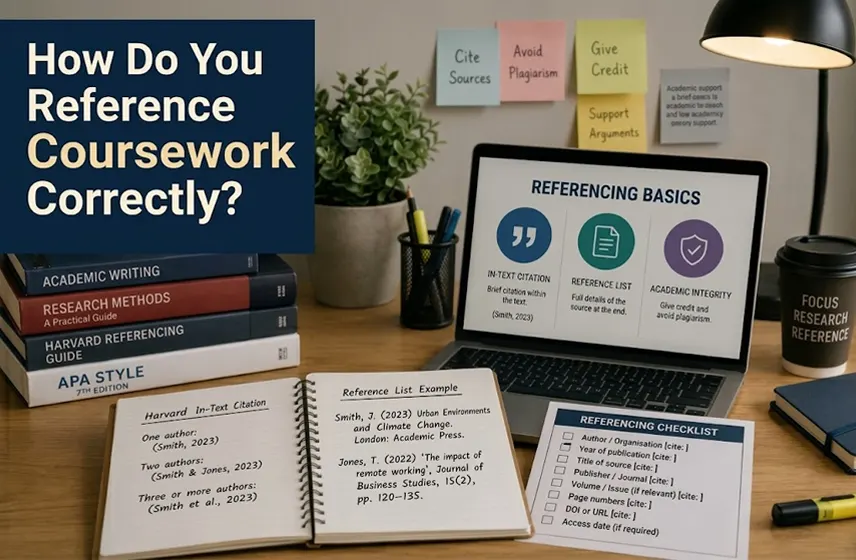
Reference Your Sources Correctly
There is this common misconception of treating references as just a formatting requirement. Well, it is not.
References show the assessor where the ideas and evidence come from and also allow them to verify the sources. Moreover, your institute might ask for Harvard, APA, or MLA styles (read the brief to find the required referencing style). Also, follow the guidance provided by your institute rather than relying on a generic referencing template from Google.
Check both:
- In-text citations
- The final reference list
A critical shortfall that I have observed is inconsistency. A source may appear in the reference list but have no citation in the work, or a cited source may be missing from the final list.
Therefore, before you submit your coursework, always make sure to check:
- Author names,
- Publication date,
- Titles,
- URL.
Proofread Before Coursework Submission
If you have completed your coursework by following this guide, and just took a sigh of relief wondering “finally, it’s over,” WAIT…
Now comes another important stage of writing: proofreading. This is where you catch issues that can undermine an otherwise strong submission.
My advice is to note down the following Coursework Proofreading Tips on paper so you can fix the content, mark it down, and check:
- Grammar and spelling,
- Sentence structure,
- Paragraph transitions,
- Headings,
- Formatting,
- In-text citations,
- Reference list,
- Word count,
- Tables and figures,
- Overall argument and flow.
Before you start, hold on…
Do not try to check everything in one reading (this is why I suggested you write the proofreading tips on paper).
You must proofread your document on separate passes. For example, first examine your argument and structure, then check language, and finally review references and formatting.
Good to follow: If possible, leave some time between writing and proofreading. A short break can make it easier to notice awkward sentences and missing information.
Common Mistakes That Stop Students Getting a First
Here I am highlighting some of the common mistakes students make that hinders to achieve a first-class coursework grade:
- Ignoring the Exact Question - Writing about the general topic instead of answering what was asked.
- Weak Research - Depending on unreliable or outdated sources.
- Descriptive Writing - Explaining information without evaluating it.
- Poor Structure - Presenting ideas without a logical progression.
- Unsupported Claims - Making important statements without strong evidence.
- Incorrect Referencing - Missing citations or using the required style inconsistently.
- Repetition - Restating the same point without adding analysis.
- Weak Conclusions - Ending with a summary that does not answer the main question.
- Last-Minute Proofreading - Leaving no time to find all errors.
- Ignoring the Marking Criteria - Failing to align the coursework with what the marker is assessing.
And before you ignore focusing on any of these mistakes, let me tell you that I, as a professor, mostly deduct marks for these errors. So give your best and ensure submitting high-quality coursework that your professor is compelled to give you a first-class grade!
Can Coursework Help Improve Your Grades?
Sometimes students understand their subject but struggle to identify what is holding their coursework back. International students who pursue online degrees often encounter problems with academic clarity. In such situations, ethical coursework help can provide pragmatic academic support.

Ethical support includes:
- Explanation of complex topics,
- Seeking research guidance,
- Reviewing coursework structure,
- Getting feedback on argument development,
- Seeking explanation on referencing conventions,
- Proofreading and editing,
- Getting feedback on your overall coursework.
Students, remember: The purpose of acquiring external support should be to help you develop your own skills and understanding, not to replace your work.
For example, receiving feedback that your second paragraph of the main body is too descriptive, or learning how to evaluate evidence more effectively for future academic assignments. YOU CANNOT ASK THEM TO WRITE CONTENT FOR YOU.
Final First-Class Coursework Checklist
And one last time before you submit your coursework to your professor, here is a checklist you must go through to ensure that you have not missed any of this:
- Have I answered the exact question?
- Have I followed the assignment brief?
- Have I used reliable academic sources?
- Is my central argument clear?
- Have I included critical analysis?
- Is the coursework logically structured?
- Have I supported important claims with evidence?
- Are all sources referenced correctly?
- Have I proofread the final version?
- Have I checked the marking criteria?
- Is the coursework ready for submission?
Conclusion
So, in a nutshell, learning how to get a first in coursework is about developing a reliable academic process. You must start by understanding the question and marking criteria, then research with purpose and organise your ideas around a clear argument.
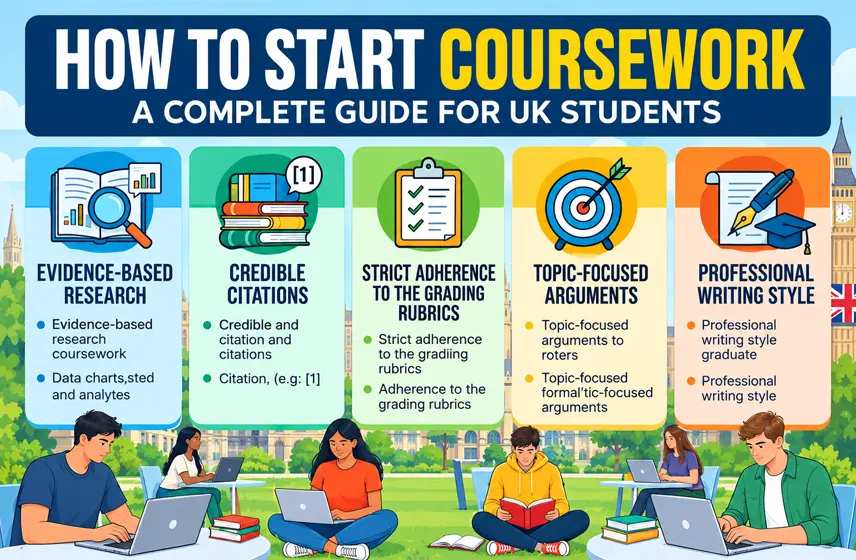
Proceed from here, and emphasize critical analysis instead of description, making good use of evidence as well as adhering to some useful coursework writing guidelines. Should you need to know how to start a coursework, you need to begin by reading through the assignment guidelines and identifying key arguments. Referencing and proofreading will be the finishing touches.
Whether you are working on your first university assignment or trying to raise your existing grades, small improvements at each stage can make your work considerably stronger. Use feedback from your professors, seek appropriate academic guidance when needed, and keep identifying what works best. That is the more sustainable way to get a first-class grade in coursework and improve coursework over time.
Frequently Asked Questions
Q1: How do I get a first in coursework?
To get a first in your coursework, you need to focus on answering the exact question, using credible academic evidence, developing a clear argument, and demonstrating critical analysis. Also, strong structure, accurate referencing and thorough proofreading matter.
Q2: What makes coursework first-class?
First-class coursework demonstrates exceptional critical thinking, original thinking, logical documentation, rigorous academic execution, clear academic writing, and accurate referencing. It should also respond to the assessment criteria.
Q3: How can I improve my coursework grades?
Start by reviewing feedback from previous assignments. You must identify the recurring weaknesses, such as weak analysis, unclear structure, or insufficient evidence, and address those areas in your next submission.
Q4: What are the best coursework writing tips?
Plan before writing, analyse the question carefully, research credible sources, create a logical structure, use evidence to support your argument, prioritise critical analysis, and proofread before submission.
Q5: How important is critical analysis for a first?
Critical analysis is often extremely important because it demonstrates that you can evaluate ideas rather than simply describe them. However, the exact weighting depends on your module's marking criteria.
Q6: Can coursework help improve academic writing?
Yes, academic support can help you understand difficult concepts, strengthen structure, improve referencing, and identify writing weaknesses. It should support your learning rather than replace your own academic work.



 +44 7933 142807
 info@writemycoursework.co.uk

