
|
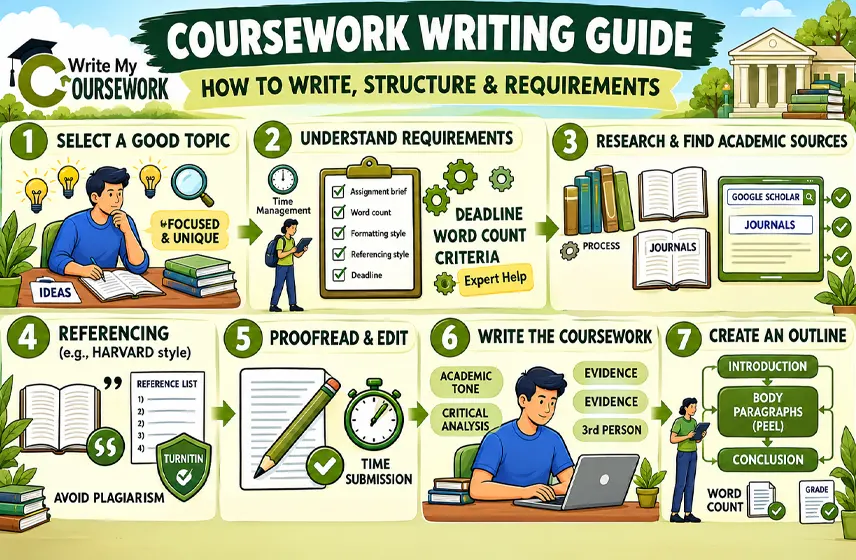
Quick Answer: To improve your coursework, decode the assessment brief and marking rubric, and use command words to structure your response. Plan your research backwards from the deadline, structure content logically (e.g., using PEEL paragraphs), and back claims with peer-reviewed evidence. Finally, edit for flow and proofread backwards to eliminate errors. |
According to the Save My Exams Student Mental Health Statistics Report, approximately 72% of UK students say that their mental health sometimes, often, and/or always affects their concentration abilities. You ask why? Reasons include fear of failure, procrastination, complex coursework requirements, and more. This eventually leads to writing low-quality coursework and receiving poor grades.
Hello, I am a Student Advisor and have worked with different UK universities for over a decade. I have seen the vulnerable side of a learner, yet their urge to get good grades. And yes, there are always doors of opportunity and improvement. If you are one of them, this guide will walk you through the steps, strategies, and some insights to improve your coursework, and certainly you will achieve a distinction.
How to Understand the Coursework Question
Can you ever score an A+ in a subject which you lack knowledge of? No, right? The same goes for writing coursework. You can not draft high-quality coursework without understanding the brief in the first place.
Why Understanding Rubrics is Important?
Any coursework that asks learners to write a response longer than a few words, rather than answering it from the given list, would probably benefit from an associated rubric.
From a UK Learner’s Perspective
The following are the common reasons why a rubric matters for a UK student:
- If you have a clear understanding of the rubrics beforehand, it will be easier to know how your work will be judged and what strategies (such as TAP or Mind-Mapping) would help to plan and take control of your learning.
- A clear rubric helps you understand mark distribution.
- Rubrics act as a coursework writing guide to evaluate your own work and help interpret any further feedback.
What To Look For in a Coursework Brief?
- Title and overview: This shows the name of the assignment, the module it belongs to, and its percentage weighting toward your final grade.
- Directive/Command words: These words explain the type of thinking required, such as whether you need to describe, analyse, or evaluate a topic.
- Learning outcomes: Details about the academic skills or knowledge you are expected to demonstrate and achieve.
- Word count and format: This specific detail tells you about the length limit and output types, such as an essay, a formal report, or a presentation.
- Submission details: A coursework brief also includes the submission deadline, time, and online platform (such as Google Classroom or Moodle).
- Special rules and AI policy: Note rules regarding referencing style, permitted sources, expectations or restrictions on AI tools.
Furthermore, I suggest that learners apply the 6 levels of Bloom’s Taxonomy to decode the coursework brief by translating assignment instruction verbs into exact markers of the critical thinking required.
How to Plan Your Coursework Before Writing
Once you have understood the coursework brief carefully, move forward to create an outline and conduct targeted research about the topic.
Break an intimidating assignment question into smaller sections by a process called chunking that helps in listing all required tasks and reducing the cognitive load.
Follow these steps to plan your coursework in a logical and structured way:
- Brain dump the tasks: Write down every single action required from start to finish. This is one of the effective coursework writing tips, which includes research, note-taking, outlining, drafting, and proofreading.
- Research and collect: Gather reliable sources, take notes, and track sources to avoid plagiarism.
- Work/Plan backwards: Look at the submission deadline and map the tasks in reverse chronological order. Assign realistic target dates to complete each section while also leaving some days to edit and proofread.
- Create micro-steps: If a task like performing research feels intimidating, then break it down further into micro-tasks, such as “finding five academic sources” or “writing down three quotes.”
How to Improve Your Academic Research?
How to do academic research? Academic research is a systematic process of gathering credible scholarly sources, analysing evidence, and synthesising findings into a structured paper.
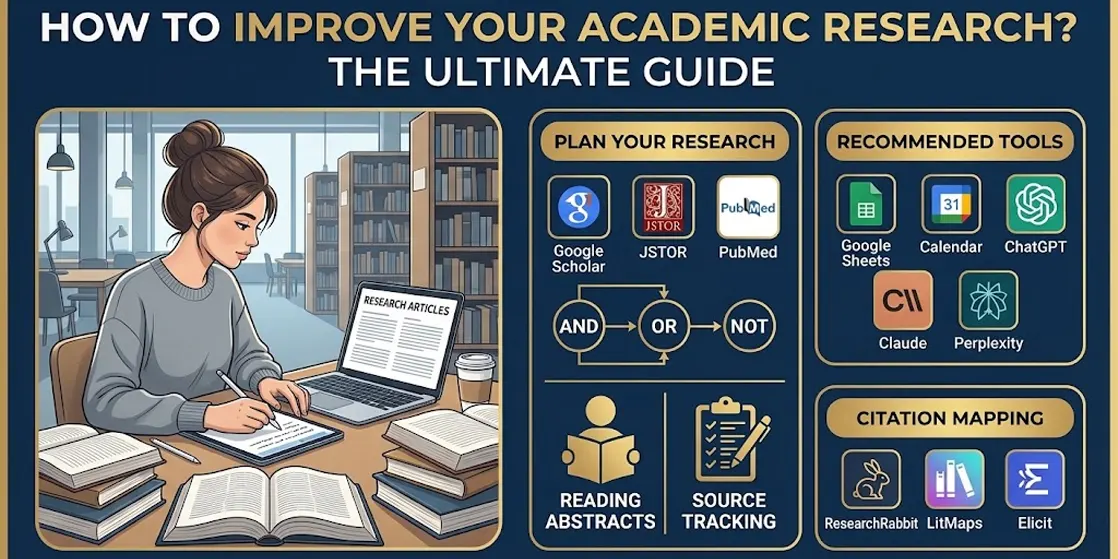
Here’s how you can plan your research:
- Search for scholarly sources: You can gather credible sources from Google Scholar, JSTOR, and PubMed, books, scholarly journals, and university sources. For targeted research, apply Boolean operators (AND, OR, NOT) alongside keywords to filter peer-reviewed journals, books, and reports.
- Read and take organised notes: Skim abstracts, introduction, and conclusions first to gauge a source’s relevance to your research question.
- Document all source details: Keep track of every source, including the author’s name, publication date, and title, to prevent plagiarism.
Recommended Tools and Strategies for Research
Research is the cornerstone of writing distinction-worthy coursework. UK learners often ask how to get better grades in coursework; that comes from following the coursework planning tips and using some efficient tools and strategies for research:
- Use digital spreadsheet trackers like Google Sheets or Microsoft Excel, or calendar apps such as Google Calendar, to block out daily or weekly research goals.
- For ideation, scoping, and outlining, you can use AI tools, such as ChatGPT, Claude, and Perplexity.
- Use ResearchRabbit, LitMaps, and Elicit to map citation networks and to track key developments in your research field.
How to Create a Strong Coursework Structure?
One of the common questions UK learners ask is how to structure coursework because that holds great marks. Well, to structure standard academic coursework like an essay or a project, use a logical and linear four-section structure that consists of:
- Introduction
- Main body
- Conclusion
- Reference list
For Extended Research or Lab Report Structure
- Abstract: This is a concise 150-to-250-word summary for the entire project which includes your research question, methods, key findings, and results.
- Methodology: Provide steps, tools, and process you used to gather data or conduct experiments so another researcher can replicate your work.
- Results and discussion: This section presents your raw findings clearly, then interprets what those results mean in the context of your original research and aims.
- Reference list/bibliography: Accurately cite all external sources, data points, and literature review using the required formatting styles (APA, Harvard, or MLA).
Throughout your coursework, well-structured individual paragraphs that flow logically into each other are essential. So here are some tips and strategies for this:
- Apply the PEEL Paragraph: This framework acts as a clear blueprint so that your paragraphs flow logically and meet the strict university criteria. PEEL stands for Point, Evidence, Explanation, and Link.
- Topic sentences: Every paragraph must begin with a clear sentence that introduces one key point which also directly supports the main argument.
- Cohesion and signposting: Logical flow must be maintained in paragraphs in a sensible sequence (such as chronological, thematic, or from general to specific) and use transition words (like furthermore, in addition, in contrast, however) to guide the reader smoothly between ideas.
How To Write a Better Coursework Introduction
To write a better coursework introduction, use the What, Why and How framework to set up your core argument in about 10% of the total word count.
- The What (Purpose): Introduce the main topic, define key terms, and set the baseline context so the reader knows exactly what you are discussing.
- The Why (Significance): Explain why the topic matters, what problem it solves and why the reader should care (such as addressing a research gap in research or a real-world issue).
- The How (Structure and Thesis): Outline your method, roadmap, or the steps you will take to explore the topic.
How to Strengthen Your Main Arguments
To develop clear arguments that move beyond simple description, you must shift your focus from telling the reader what happened to explaining why and how it matters.
- Critical thinking and analysis: Critical thinking is the practice of questioning and evaluating information rather than accepting it at face value. For example, description answers the “What?” (e.g What is the policy? What does the data show?). Analysis answers the How and Why (e.g., Why did this outcome occur? How does this limitation affect the overall conclusion?)
- Develop analytical arguments: You need to persuade, evaluate, and prove a specific point while also weighing the strengths, weaknesses, and biases of sources. Ensure you structure it in a logical chain of reasoning built around the main thesis question.
- Integrate evidence and examples effectively: Do not drop evidence or statistics without explaining it. Apply the “evidence sandwich” technique like this:
- Introduce the evidence (the top): Frame the context of the data or quote and also state what this evidence is going to support.
- Present the evidence (the filling): State the concrete example, quote or statistic clearly and concisely. Always attribute it to a credible source.
- Analyse the evidence (the bottom): Explicitly explain how this specific piece of evidence proves your initial claim.
How to Improve Academic Writing Style
To improve academic writing, focus on clarity, logical paragraph structure, and strong evidence-based arguments rather than overly complex language.
The following are some effective coursework writing tips for better academic writing:
- Prioritise sentence-level clarity: Express one idea clearly per sentence. Also, make sure to use active voice where possible and avoid excessive jargon. In addition, replace weak nominalisations (e.g., nouns ending in -tion) with strong action verbs.
- Structure paragraphs cohesively: focus each paragraph on a single, unified argument. Use the funnel method to specify evidence, and ensure each paragraph ends with a transitional link to the next.
- Think and write critically: Do not just summarise sources; evaluate different perspectives, highlight gaps in the literature, and build your own supported claims using accurate reporting verbs (e.g., argues, demonstrates, refutes).
- Read voraciously: Most users on AskAcademia agree that becoming a better writer requires becoming a voracious reader – both of high-quality non-academic prose and top-tier papers in your specific subfield.
How to Use References Correctly
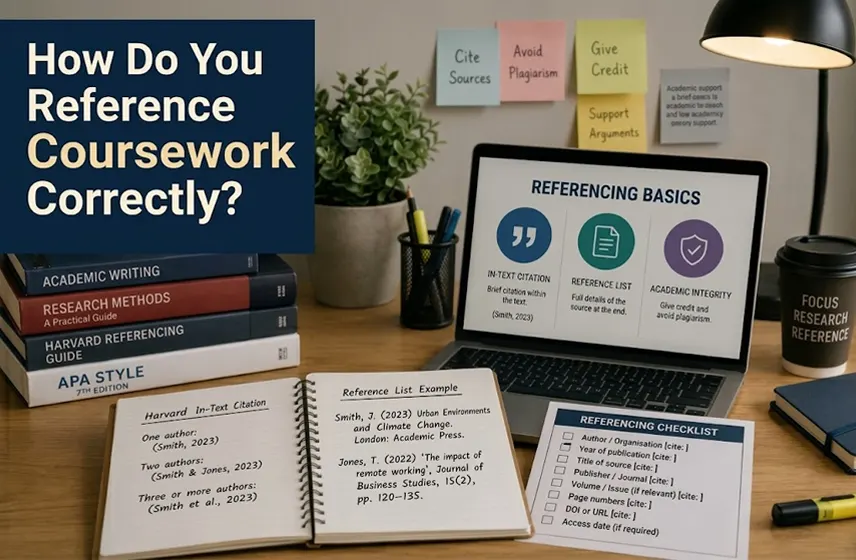
Referencing is a fundamental pillar of academic writing that validates your research, demonstrates your engagement with scholarly sources, and upholds academic integrity. It functions as a roadmap for readers to Reference Coursework Correctly differentiate between sourced ideas and your own thoughts.
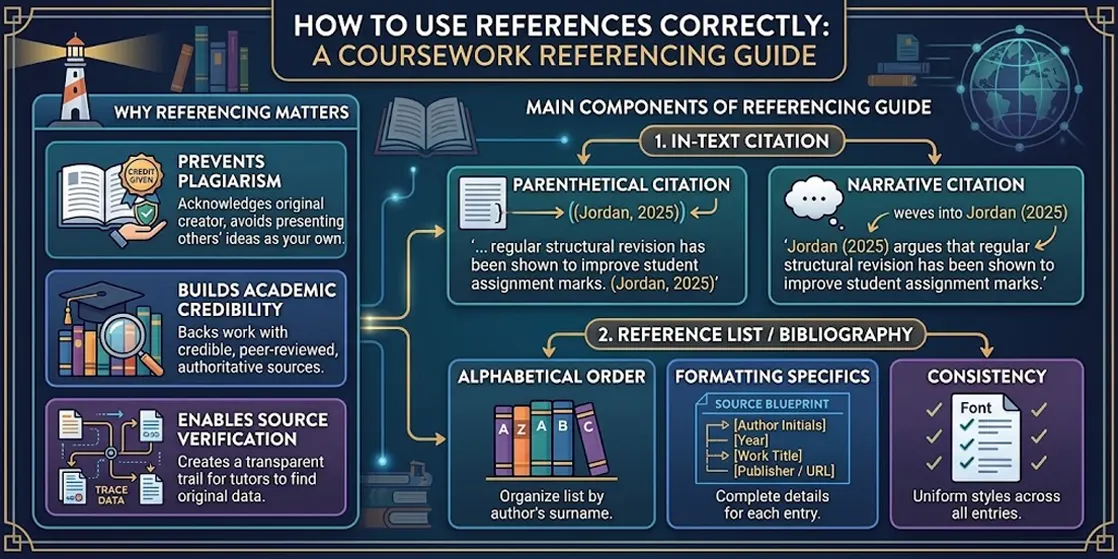
Here’s why referencing matters in academic tasks:
- Prevents plagiarism: It acknowledges the original creator, ensuring that you do not present someone else’s data, text, or ideas as your own.
- Build academic credibility: Referencing means citing peer-reviewed and authoritative sources, which tells your professor that your work is backed by credible research.
- Enables source verification: It creates a transparent trail that allows tutors to locate, track, and verify the original data easily.
Main Components of Coursework Referencing Guide
1. In-text citation
Place a short tag (author’s surname and publication year) within the text or in a footnote near the borrowed information.
- Parenthetical citation: The source information is placed entirely within brackets at the very end of the sentence. For example, regular structural revision has been shown to improve student assignment marks (Jordan, 2025).
- Narrative citations: The author’s name is woven naturally into the sentence structure, followed immediately by the year in brackets. For example, Jordan (2025) argues that regular structural revision has been shown to improve student assignment marks.
2. Reference list/bibliography
Every single source flagged in your content must have a corresponding entry in a reference list at the very end of the document. If you do not cite a source in the text, it should not appear in this list.
Alphabetical order: Organise your reference list alphabetically by the primary author’s surname.
Formatting specifics: Each entry must contain the complete publication blueprint, including author initials, publication year, title of the work, publisher or URL, and access dates for digital media.
Consistency: Ensure publication, spacing, italics, and font styles are uniform across all entries.
How to Proofread and Edit Your Coursework
Proofread and edit your coursework by separating the big-picture Editing phase from the detail-oriented Proofreading phase to polish your arguments and eliminate mechanical errors.
Stage 1: Editing (The Big Picture)
Editing is the first step you do after completing your coursework draft. This stage focuses on content, structure, and flow.
Here’s what you need to do to edit the content:
- Check against the content: Reread your assignment brief and assessment rubric. Ensure you have explicitly answered the primary question and met all learning outcomes.
- Build a reverse outline: In the margins of the draft, write a single sentence summarising the main point of each paragraph. This helps you see if your argument flows logically and if any sections are repetitive or out of order.
- Evaluate the structure: Every paragraph should begin with a clear topic sentence that introduces a single main idea. You must also ensure that every supporting sentence directly backs up that topic sentence and links back to your core thesis.
- Trim the clutter: Look for wordy academic phrasing and replace it with direct, concise sentences. Also, remove filler words (such as completely, basically, actually) and redundant arguments.
Stage 2: Proofreading (Minor Details)
Proofreading is looking for specific types of errors, which include grammatical errors like typos, punctuation, and formatting. Follow these coursework proofreading tips to spot every error effortlessly:
- Read aloud for sentence structure: Read your coursework out loud or use a digital text-to-speech tool (like Microsoft Word’s Immersive Reader). If you stumble over a sentence or run out of breath, the sentence is too long or incorrectly punctuated.
- Read backwards for spelling: Start at the very last sentence of your essay and read backwards to the beginning. This completely shifts the narrative flow, forcing your mind to look strictly at individual words and typos
- Check citations and references: Verify that every single in-text citation matches an entry in your final bibliography. Ensure your formatting strictly adheres to your department’s specific style guide (e.g Harvard, APA, MLA).
- Final layout check: Ensure consistency in margins, line spacing, font sizes, and heading formats.
Common Coursework Mistakes to Avoid
Avoiding common coursework mistakes is essential to improve your academic writing. The following are the mistakes to look for in your task:
- Weak research: Learners often rely on random blogs or Wikipedia as their primary source of data collection, which undermines the entire argument (UKSG Insights). Ensure you avoid this mistake by using peer-reviewed articles, journals, and books as the foundation of your research and to show that you have a good understanding of the topic.
- Poor structure: Writing without a logical flow confuses the reader and hides the key points. A strong structure involves a clear introduction, a critical main body section, and a conclusion that ties everything together seamlessly.
- Unsupported claims: Making statements without backing them with strong evidence reads like your personal opinion rather than academic writing. Every assertion or argument you make must be verified by facts, statistics, or expert citations.
- Off-topic information: Adding extra details that do not answer the assignment prompt dilutes your argument and wastes your word count. Make sure to stay strictly focused on the assignment brief and delete any tangents.
- Repetition: Do not repeat the same points because it leads to a lack of depth. Make your point clearly once, support it with evidence, and move on to the next part of your argument.
- Incorrect referencing: Failing to format citations properly or mixing styles can cost you easy marks. Worse, missing references entirely can lead to accidental plagiarism and serious academic penalties.
- Submitting without proofreading: Handing in a first draft leads to preventable spelling errors, grammatical mistakes, and broken sentences. Always take a break after writing, then read your work aloud to catch errors and polish the final tone.
How Coursework Assistance Can Support Students
Coursework Help UK provides structured digital academic support such as guidance, editing, drafting help, and feedback to help learners complete their assignments and manage their workloads effectively.
In addition, students can also get academic writing help in other forms, such as:
- Understand the question.
- Improve structure.
- Strengthen research.
- Develop critical analysis.
- Improve academic writing.
- Edit and proofread.
Important point:
Students! Remember that you are mainly responsible for researching the topic, developing arguments, and following your university’s academic guidelines. Therefore, seek coursework assistance responsibly to get feedback, editing, and proofreading help.
Final Coursework Improvement Checklist
Before submitting your coursework, use this checklist to make a final review:
- Answered the question: Have you addressed every part of the assignment question?
- Clear structure: Does your introduction establish the topic, and do your paragraphs follow a logical order?
- Strong research: Have you used relevant, credible, and sufficiently recent academic sources?
- Critical analysis: Have you evaluated evidence, compared perspectives, and explained the significance of your findings?
- Correct referencing: Are your in-text citations and reference list consistent with your required referencing style?
- Proofreading: Have you checked grammar, spelling, punctuation, sentence clarity, and formatting?
- Meets word count: Is your coursework within the required word limit?
- Follows university guidelines: Have you followed the assignment brief, formatting requirements, submission instructions, and academic integrity rules?
Final Thoughts
Improving your coursework comes down to clear planning, strong research, critical analysis, and careful editing. Before submitting, make sure you have:
- Answered the question directly
- Used credible academic sources
- Developed clear, evidence-based arguments
- Followed a logical structure
- Referenced sources correctly
- Proofread and checked the marking criteria
Need extra support? Coursework Help UK can provide responsible guidance, feedback, editing, and proofreading to help you improve your own academic work. Get the support you need and submit your coursework with confidence.
Frequently Asked Questions
Q1: How can I focus 100% on studying?
Achieving 100% continuous focus is unrealistic; however, you can maximise your concentration with the following tips:
- Manage your environment while studying by dedicating a specific area for studying and using digital blockers on your phone.
- Use the Pomodoro technique and make a granular checklist to focus on specified tasks at a time.
- Schedule complex tasks during your personal peak energy hours of the day, and take good care of yourself by getting enough sleep and eating healthy.
Q2: What are the 7 secret methods for studying effectively?
The following are the seven science-backed methods for studying effectively:
- Active Recalling: Forcing your brain to retrieve information from your memory using flashcards, practice questions or self-quizzing.
- Spaced repetition: Review materials at gradually increasing intervals over time to combat the forgetting curve and move into long-term memory.
- Feynman technique: Explain a complex topic in simple, plain language as if teaching it to a beginner; this exposes the gap in your understanding.
- Mind mapping: Organise information visually in a hierarchical diagram to connect related subtopics and see the bigger picture.
- SQ3R method: A structured reading comprehension approach standing for Survey, Question, Read, Recite, and Review, it helps you process and retain written information from dense textbooks and articles.
- Environment optimisation: Removes digital tools while improving lighting, and separates yoru study area from your rest area to give your brain signals to focus.
- Pomodoro technique: Work in high-focus sprints (20-25 minutes) followed by a small 5-minute break for a physical activity to maintain concentration and prevent burnout.
Q3: What makes a good coursework assignment?
A high-quality UK university coursework is defined by rigorous critical analysis, a logical, linear structure, an evidence-based foundation, and adherence to the assignment brief.
Q4: How can I improve my academic writing for UK coursework?
Improve your UK coursework by following these guidelines:
- Decode the prompt and check the given guidelines.
- Ask ‘so what’ questions for critical analysis and synthesise sources by themes, agreements or disagreements.
- Ensure structure and flow in the content by ensuring every main body paragraph starts with a topic sentence, guiding the reader through signposting and writing a logical conclusion that ties up key arguments.
- Avoid to use informal language or emotive phrasing, and also reread the guidelines to check the first-person rules.
Q5: How to avoid being lazy while studying?
To avoid feeling lazy while you are studying, you need to lower the friction of starting and manage your brain’s energy levels rather than relying entirely on willpower. Trick your brain into starting by saying that you will study for only 5 minutes, then set a timer and work on small tasks first to release the cognitive load of completing X number of tasks. It is best to use the Pomodoro technique and the Flip Flop strategy. Also, fix your environment by moving your phone away, fix your posture, and go for a walk in sunlight to suppress melatonin (the sleep hormone), and then get back to your academic writing.




 +44 7933 142807
 info@writemycoursework.co.uk

